
Tamper-evident labels are one of the simplest and most overlooked tools in medication safety. This guide breaks down what they are, where they fall short, and how DosePacker’s compliance packaging takes protection a step further – at the dose level, every single time.

Picture this: it is the evening med-pass, and a caregiver reaches into the storage room for a resident’s medication pack. It looks exactly as it should: label facing forward, sitting neatly in its spot. Everything appears fine. But appearances in a medication room can only tell you so much. Without a tamper-evident label, there is no reliable way to know whether that pack has been opened, accessed, or tampered with since it was last dispensed.
This is not an unlikely scenario. Medication errors affect millions of people each year, and an estimated 44,000 to 98,000 deaths annually in the United States are linked to preventable medication errors; a number that includes incidents where compromised, diverted, or tampered medications played a role. And yet, tamper-evident security labels, one of the simplest and most cost-effective tools in pharmacy safety, remain inconsistently applied across care settings.
This guide breaks down what tamper-evident security labels are, where they fit into your medication safety program, and how DosePacker’s compliance packaging goes a step further, building verification into every dose, not just the package.
Before diving into how to use tamper-evident labels effectively, it helps to understand exactly what they are and what they are designed to do.
A tamper-evident label is a seal designed to show visible signs of interference if a package has been opened, accessed, or altered after it was dispensed. Unlike a standard label that can be peeled off and reapplied without leaving a trace, tamper-evident security labels leave behind a clear physical indicator: a broken seal, a void pattern, or a torn perforation that tells anyone who picks up that pack that something is not right.
In pharmacy settings, that visible indicator is everything. It is the difference between a caregiver administering a medication with confidence and one making a judgment call based on nothing more than how a pack happens to look.
Tamper-evident labels are not just a best practice. They are a frontline safety tool, and the risks they address are real, documented, and more common than most care communities realize.
A medication that has been tampered with can cause serious harm to the person receiving it. Medication diversion, particularly of controlled substances, remains one of the most persistent problems in care settings. And when surveys and inspections come around, the absence of a documented tamper-evident process is exactly the kind of finding that can lead to regulatory consequences.
Tamper-evident security labels address all three of these risks simultaneously: making tampering detectable, making diversion harder to conceal, and strengthening compliance documentation throughout the medication journey.
Having tamper-evident security labels available is not the same as using them well. The way they are applied, checked, and documented determines whether they actually strengthen your medication safety program, or just sit in a drawer somewhere.
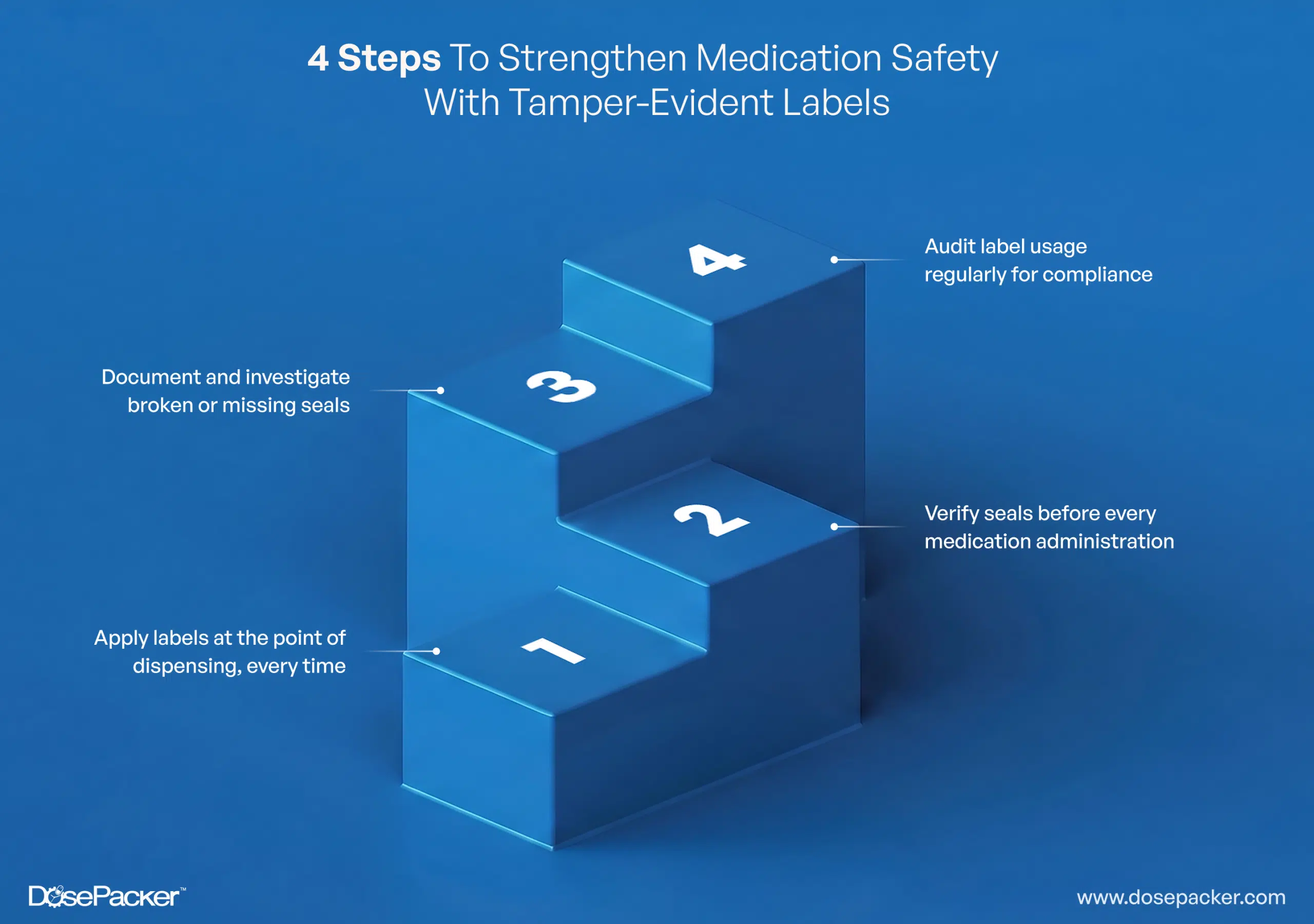
Every medication dispensed should receive a tamper-evident label before it leaves the pharmacy or medication room. This is a non-negotiable step, not something left to individual judgment or skipped when things get busy. If it is not embedded as a required, documented step in your dispensing workflow, it will not happen consistently. And inconsistency is exactly what creates the gaps that put residents at risk.
A tamper-evident label only does its job if the person administering the medication actually looks at it before opening the pack. Build label verification into your medication administration protocol as a standard step, alongside the right resident, right medication, right dose check. Staff should know what an intact tamper-evident security label looks like, what a compromised one looks like, and exactly what to do when something does not look right.
If a tamper-evident label is found broken or missing without explanation, document it right away. Your incident reporting process should treat tamper-related findings as a distinct category, allowing patterns to be tracked and investigated before they escalate into more serious incidents.
Include tamper-evident label compliance in your regular medication management audits. The questions that matter:
These questions deserve documented answers. When a survey comes, “we generally do this” is not a defense.
Here is the honest truth about tamper-evident labels: they are a starting point, not a complete solution. A tamper-evident label confirms that the packaging has not been opened. What it cannot tell you is whether the right medication is inside, whether the dose is correct, or whether it belongs to the right resident. A label on a bottle is one layer. In a care community managing complex medication regimens across multiple daily med-passes, one layer is not enough.
This is exactly the gap DosePack was built to close.
DosePack is DosePacker’s technology-enabled compliance packaging system, and it does not treat tamper evidence as a label you apply at the end of the dispensing process. It makes any discrepancy or interference with the medication immediately visible. With features like:
Each dose cup in a DosePack has a perforated label. Once a dose cup has been opened, the tear is immediately visible. There is no resealing it, no hiding it. Any caregiver who looks at it knows exactly what they are dealing with before they administer anything. It also allows staff to tear away a single dose or a full day’s supply for off-site use, such as medical appointments or family outings, without losing any labeling or compliance information.
Every DosePack compliance pack displays the resident’s name, medication name, dosing time, and a clear, high-resolution image of the pill. For new staff, temporary caregivers, or anyone who did not personally dispense the pack, verification occurs before anything is opened. The packaging is doing the safety work, so your team does not have to rely on memory.
Green for morning, red for noon, yellow for evening, blue for bedtime. DosePack’s color-coded compliance packaging lets any caregiver verify the right dose at a glance, no paper charts, no manual cross-referencing, no second-guessing under the pressure of a busy med-pass.
When a caregiver scans the QR code on a DosePack using the MyDoses app, the app confirms the correct medication, logs the administration in real time, and automatically updates the electronic medication administration record. Tamper evidence is no longer just a visual check; it is a documented, time-stamped, digitally verified event every single time a dose is administered.
With over 560K+ compliance packs delivered and more than 350 care communities served, DosePack has become the standard for medication compliance packaging that takes safety seriously, from the moment it is dispensed to the moment it reaches the resident’s hand.
Tamper-evident labels are a non-negotiable. Every care community, pharmacy, and home health setting should use them consistently, verify them at every administration, and document any findings immediately. That is the baseline.
But the care communities that manage medication safety most effectively are not the ones that stop at the baseline. They are the ones where every step from dispensing to administration is accounted for, where the compliance packaging, the digital record, and the caregiver workflow all tell the same story, every time.
That is what DosePacker’s compliance packaging delivers. Because medication safety should not depend on someone remembering to look at a label. It should be built into the system from the start, at the dose level, at every med-pass, for every resident.
