
Starting a new medication is one of the most common moments for confusion and medication errors. This guide breaks down the 10 questions every patient and caregiver should ask, and how DosePacker’s compliance packaging helps improve medication adherence from the very first dose.

Margaret is 72 and has managed her own health for decades. Last Tuesday, her doctor added a new blood pressure medication. The appointment was ten minutes. She left with a prescription and a printout she has not opened since.
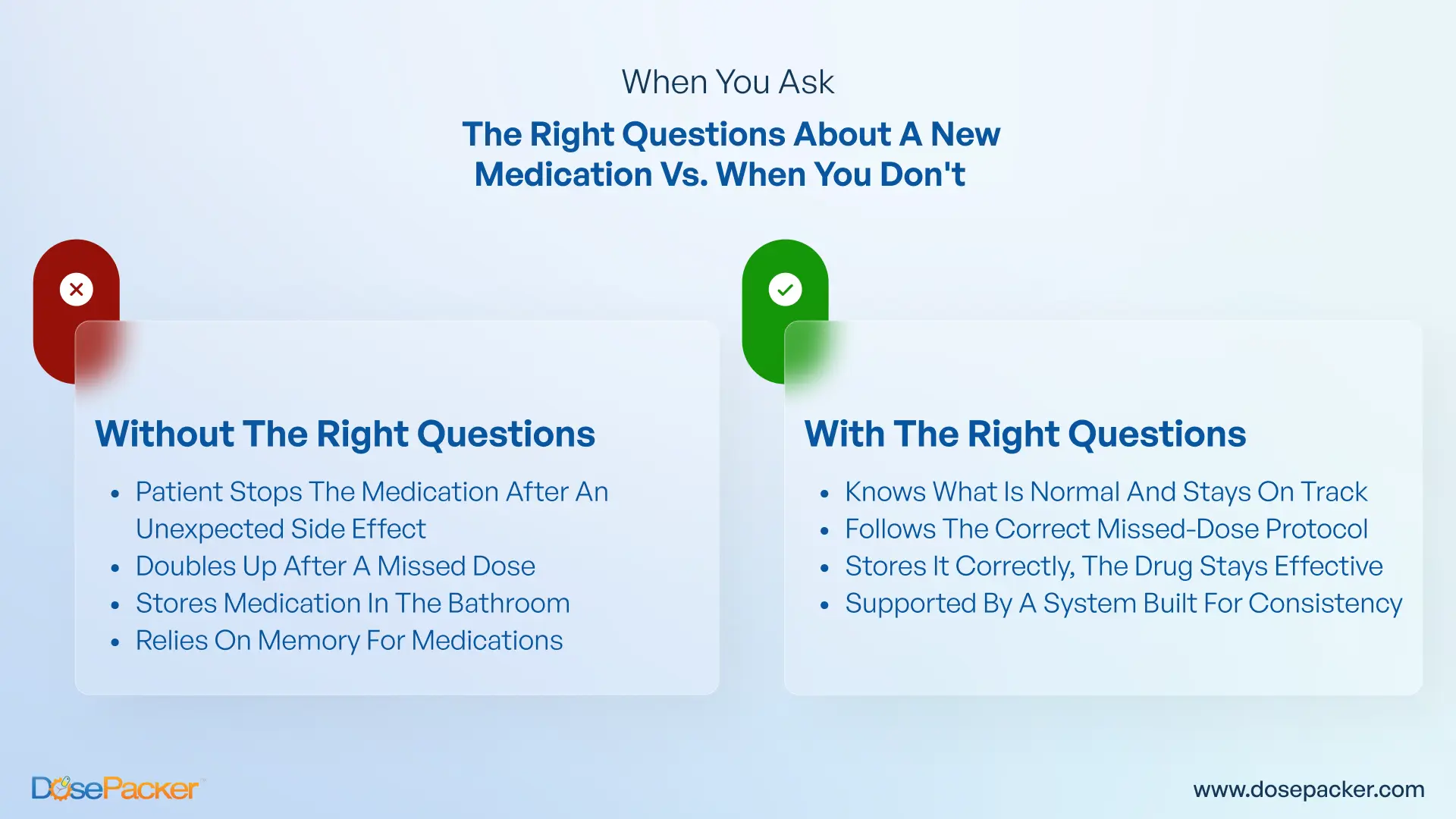
Three weeks later, she stopped taking it. Not because it wasn’t helping, but because her numbers had begun to improve. She stopped because she felt dizzy every morning and assumed something was wrong. Nobody told her that mild dizziness is completely normal in the first two weeks. So she did what felt safest. She stopped.
Margaret's story is not unusual; it is the norm. According to research, medication non-adherence affects as many as 40-50% of patients managing chronic conditions and is estimated to cause at least 125000 preventable deaths and $300 billion in avoidable medical costs every year in the United States alone. Not because medications don't work, but because the gap between "here's your prescription" and "here's everything you need to know" gets cut short almost every time.
DosePacker’s compliance packaging system was built for exactly this reality; for care communities where dozens of residents depend on every dose being right, every time, without anyone relying on memory alone. But even the best system cannot undo the confusion that arises when a new medication is added to a regimen without the right conversation. The questions have to come first. Here are the ten that matter most.
Think about the last time you or someone you care for started a new medication. How much of that conversation covered what to expect: the side effects, the interactions, and what to do if a dose is missed?
Most patients leave with the basics and fill in the rest themselves. And that guesswork is exactly why medication management is crucial.
For patients managing their own care, asking questions can feel uncomfortable, as if it's taking up a busy prescriber's time. For caregivers in long-term care communities, one unanswered question does not affect one person. It ripples across dozens of residents and hundreds of doses. DosePacker's compliance packaging catches a lot of what slips through, but the conversation still has to happen first.
Most prescribing conversations are short. The questions below are not meant to slow things down; they are meant to make sure you walk out with what you need to know. Ask them at the appointment, at the pharmacy, or in a follow-up call. The answers will shape everything that comes after the first dose.
It sounds basic. It often goes unasked. But understanding what a medication is doing is one of the clearest predictors of whether a patient will stick with it. Margaret's blood pressure medication was quietly protecting her from a future stroke. She had no idea. Without that context, the dizziness had nothing to compete with. Ask for the plain-language version, not just the drug name.
Dosing is not universal. The same medication gets prescribed at very different levels depending on age, kidney function, other medications, and expected response. Knowing whether you are starting at a low dose that will be adjusted or at the therapeutic target sets realistic expectations. In care communities, how to measure medication adherence accurately depends on knowing what the correct dose is at every point in treatment. DosePacker's compliance packs reflect that information on every unit, so caregivers always have the right details before opening anything.
"Once daily" leaves a surprising amount of room for error. Should it be at the same time every day? With food or without? Can it be crushed? Some medications need to be swallowed whole because splitting the tablet changes how it is released, and not in a minor way. Getting these details right is one of the most practical medication safety tips available, and it takes about sixty seconds to ask.
What do most patients actually experience? What is temporary? What is a side effect that feels alarming but is completely normal in the first few weeks?
That last category is where medication adherence most often breaks first. Margaret's dizziness was expected and would have resolved on its own. Nobody told her. So she stopped a medication that was working. Ask specifically what is common, what goes away, and what would warrant a call.
The resident who eats grapefruit every morning does not know that it is cutting the absorption of her new cholesterol medication in half. The caregiver who gives an antacid at 8 a.m. and an antibiotic at 8:15 a.m. does not know that they need 2 hours between them. Nobody told them, because nobody asked.
Drug and food interactions are one of the most significant risks in medication management for patients on complex regimens and one of the most skipped conversations at the prescribing level.
Everyone will miss a dose eventually. The question is whether they know what to do when it happens. For some medications, taking them as soon as you remember is fine. For others, like blood thinners, immunosuppressants, and certain psychiatric drugs, a missed dose requires a call before anything else. Without this answer in advance, people guess. Sometimes the guess is fine. Sometimes it is not. Knowing the protocol is one of the simplest, most overlooked pieces of how to improve medication adherence over time.
A ten-day antibiotic and a lifelong blood pressure medication require completely different mental frameworks. Patients who do not know which one they have end up confused when refills keep coming for something they assumed would end, and they start skipping doses without telling anyone. For care communities, this question matters for care planning, too. Medication management for patients in long-term care requires knowing which medications are chronic and updating plans accordingly. The future of medication management lies in systems that track this seamlessly, but it starts with asking at the prescribing conversation.
Most people keep medications in the bathroom. Most medications should not be in the bathroom. Temperature swings, humidity, and steam from showers degrade many drugs faster than people realize, and that is before accounting for medications that require refrigeration or protection from light. These are medication safety tips that get skipped in handoff conversations and quietly matter over time. In care communities, storage is a regulatory matter, not just a best practice.
For some medications, feedback is obvious – the infection clears, the pain eases, and breathing improves. For others, like blood pressure medications or statins, nothing feels different daily. That absence of feedback is one of the quieter reasons medication adherence erodes. Knowing in advance how success will be measured- a lab value, or a blood pressure reading at the next visit, gives patients something to hold on to. Medication adherence apps can help bridge the gap with tracking and reminders, but the benchmark still needs to come from the prescriber.
This is the question almost nobody thinks to ask and the one with the most immediate payoff.
Most patients leave appointments relying on a pill organizer and a phone alarm when much stronger medication adherence tools are available. Compliance packaging, digital medication tracking, caregiver-facing administration systems – these exist, they work, and most patients never hear about them.
Ask your pharmacist what support systems they offer. For care communities, ask about tools that build consistency into the dispensing and administration workflow, rather than relying entirely on individual memory during a busy med-pass.
That is exactly where DosePacker's compliance packaging is designed to help. Each DosePack simplifies medication administration through:
Instead of relying on caregiver memory at the bedside, the packaging itself becomes part of the medication adherence process. Every dose verified. Every administration is logged. Every med-pass is documented.
With more than 560,000 compliance packs delivered across over 350 care communities, DosePacker helps pharmacies and senior care teams build medication workflows that are more organized, more verifiable, and easier to manage consistently, every single day.
Margaret eventually called her pharmacist, who explained that the morning dizziness was expected, was already improving, and would be gone within a week. She restarted her medication that afternoon.
What she needed was not complicated. She just needed the questions answered that should have been answered three weeks earlier.
That is what this guide is for.
What is this medication for? How and when should it be taken? What happens if something goes wrong? How do we stay consistent over time?
Those conversations create clarity before confusion has the chance to grow. And once that clarity exists, tools like DosePacker's compliance packaging carry it forward, through every dose, every med-pass, and every stage of medication management that follows.
Because medication adherence works best when it is built into the process from the very beginning.
