
The RHT grant is the largest rural healthcare investment in decades, but its impact depends on the right systems behind it. Here’s how DosePacker’s solutions help rural care communities reduce medication errors and close documentation gaps.

In rural healthcare, small process issues tend to grow quickly. A delayed dose, a missed entry in a record, or confusion around prescriptions can affect not just one patient, but an entire care routine. Research continues to show that patients in rural areas face lower medication adherence rates and higher risks of medication-related complications than their urban counterparts.
The RHT Grant, part of the Rural Health Transformation Program, was introduced to address challenges like these at a system level. With $50 billion available through 2031 and CMS backing the effort, the rural health transformation program is not a short-term patch. It is a real investment in rebuilding what rural care should look like.
Yet, funding by itself does not change how care is delivered day to day. The shift happens when everyday workflows become more consistent and easier to manage. In many cases, that shift begins with medication management, because it touches nearly every aspect of patient care.
That is where DosePacker comes in.
The Rural Health Transformation Program is a federal initiative administered by CMS that is built around the idea that rural healthcare needs stronger, more reliable systems. It encourages providers to rethink how care is organized, how teams coordinate, and how outcomes are tracked over time.
For many organizations, this means taking a closer look at processes that have been in place for years. Medication workflows are often part of that reflection. They tend to rely on manual effort, and over time, small inefficiencies become part of the routine.
Under the Rural Health Transformation Program, those routines are being questioned. Providers are expected to show improvement in patient outcomes and operational performance, which makes consistency in daily processes more important than ever.
Ask anyone who runs a rural care community what keeps them up at night, and medication management is usually somewhere in the top three. It is one of the most scrutinized areas during surveys and one of the most consequential domains for resident safety. It is also one of the hardest to get consistently right when staffing is tight, and your workforce includes agency caregivers who may be working a shift for the first time.
The rural health transformation program puts a heavy emphasis on improving health outcomes and building sustainable care delivery systems. That maps directly to medication management. Preventable errors, audit gaps, and packaging not designed for a care environment are exactly what drive poor outcomes and unsustainable operations in rural care communities.
Rural care communities often have smaller staffing ratios than their urban counterparts. They rely more heavily on agency coverage. They have less administrative bandwidth to absorb compliance failures. And when a medication error happens in a rural setting, the window to catch it before it becomes a survey finding or a harm event is often narrower than it would be elsewhere.
And the RHT grant exists, in part, to help rural care providers close exactly these kinds of structural gaps.
The changes encouraged by the Rural Health Transformation Program often begin with simple questions:
Can this process be made clearer? Can it be made easier to repeat without error?
DosePacker fits into this conversation by focusing on how medications are packaged and handled before they reach the patient.
Here is what that looks like in practice.
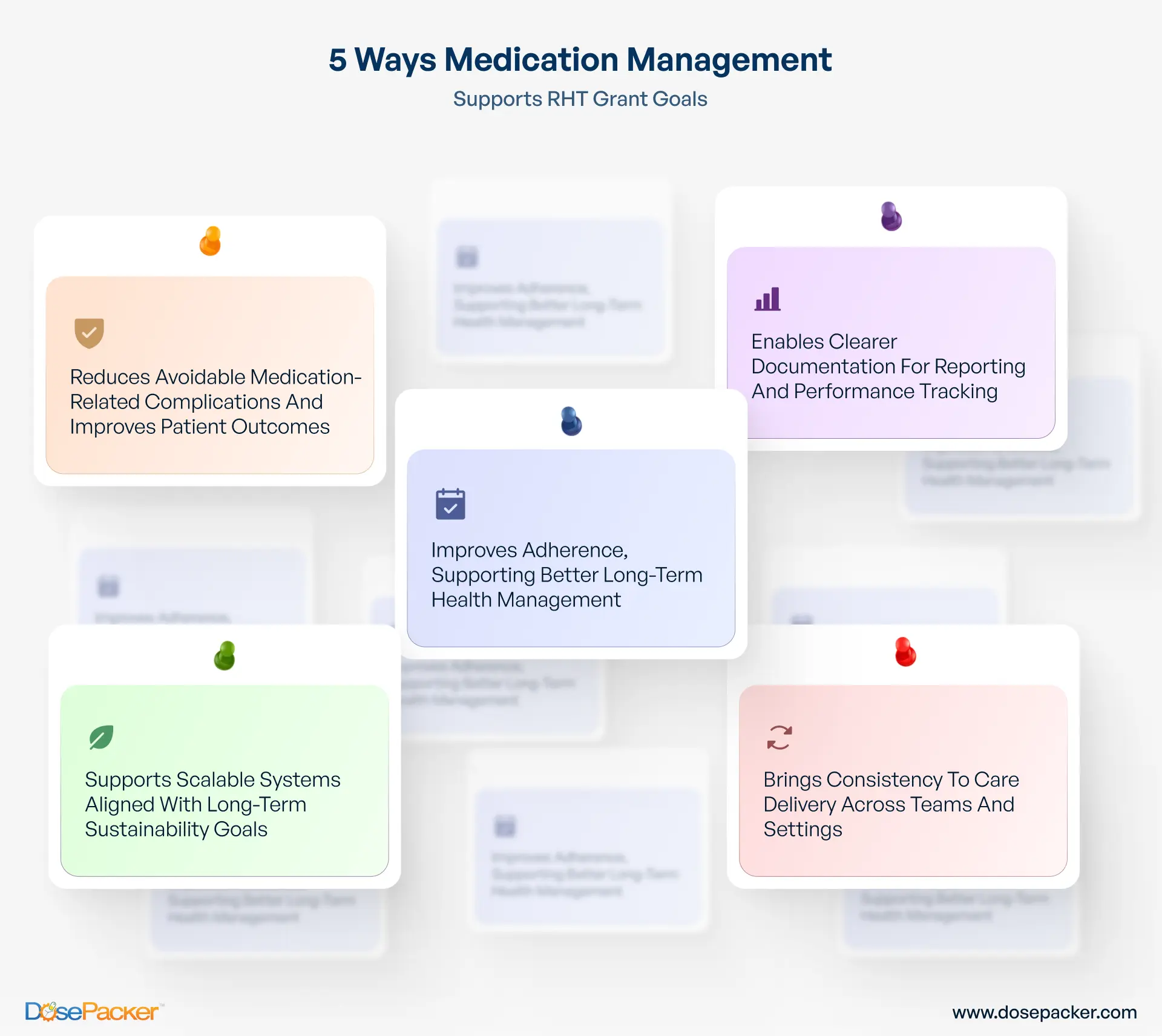
Instead of relying on traditional packaging that requires sorting and interpretation, DosePacker’s compliance packs organize medications into clearly labeled dose packs. Each pack is arranged by timing and dosage, which gives caregivers a clearer starting point.
This approach reduces the need for repeated checks and lowers the chance of confusion during busy care routines. Over time, it helps create a steadier rhythm in medication administration.
For patients, especially those managing multiple prescriptions, clarity makes a noticeable difference. When medications are easier to follow, adherence improves naturally.
DosePacker’s multi-dose compliance packaging simplifies the experience by presenting medications in a way that aligns with daily routines. Patients and caregivers do not have to repeatedly interpret instructions, which makes the process feel more manageable.
Within the scope of the RHT Grant, improved adherence contributes directly to better health outcomes and more consistent reporting.
Documentation is often where gaps begin to appear. When records are updated later in the day, small details can be missed or misremembered.
With a more structured medication system in place, documentation becomes easier to align with the medications that have been administered. The process feels less like a separate task and more like a natural part of the workflow.
For providers working under the Rural Health Transformation Program, this level of clarity supports both compliance and long-term tracking.
The rural health transformation program is explicit about sustainability. The goal is not improvement that lasts until the funding runs out. It is infrastructure that holds up as rural populations age, staffing pressures persist, and regulatory expectations increase.
DosePacker is built as a connected ecosystem: compliance packaging that integrates with CareCommunityOS, DosePacker Storage, and the MyDoses app to create a complete workflow from dispensing and administration to documentation. That consistency does not erode as the community grows. It scales with it.
Rural healthcare providers are often asked to expand their reach while working with limited resources. Growth brings new challenges, especially when existing systems are already under strain.
The RHT Grant encourages expansion, but it also requires consistency. A process that works for a smaller group of patients needs to hold steady as the number of patients increases.
By introducing a more structured approach to medication management, providers can maintain consistency even as their responsibilities grow. Care routines become easier to replicate, and teams can rely on processes that feel familiar across different settings.
The RHT Grant offers an opportunity to rethink how rural healthcare operates. It encourages providers to move toward systems that are easier to manage and more consistent over time.
Within that effort, medication management stands out as an area where meaningful improvement can take shape. By introducing clearer, more organized approaches, such as those offered by DosePacker, healthcare teams can create workflows that support both caregivers and patients.
Transformation does not always come from large changes. Often, it begins with making everyday tasks simpler and more reliable, and then builds from there.
Ready to build a medication management system that meets the moment? Start with DosePacker.
