
Every pharmacy generates valuable operational data, but knowing which metrics matter most is the key to long-term success. This guide explores the essential pharmacy KPIs every pharmacy owner should track in 2026, including fill rate, medication adherence, inventory turnover, and labor costs. Learn how pharmacy analytics and connected workflow automation help improve efficiency, enhance patient care, and support smarter business decisions.

Walk into almost any long-term care pharmacy, and you'll see a familiar scene: prescriptions being verified, technicians preparing medication orders, deliveries heading out the door, and pharmacists balancing clinical care with daily operations. Behind that activity, every decision influences efficiency, patient safety, and the pharmacy's financial health.
Yet many owners still rely on prescription volume and revenue to measure success. Those numbers show what's happening, but they rarely explain why workflows slow down, inventory costs rise, or dispensing errors increase over time.
According to AHRQ, medication errors harm at least 1.3 million people in the United States each year, many of them linked to process and communication failures. Identifying operational issues before they affect patient care requires looking beyond traditional reports.
That's where pharmacy KPIs come in. When combined with meaningful pharmacy analytics, they help pharmacy owners measure operational performance, monitor trends, and make informed decisions based on real data rather than assumptions.
By connecting key medication management workflows, DosePacker helps pharmacies improve operational efficiency while providing the visibility needed to evaluate performance more effectively.
Want to see how connected pharmacy technology supports better performance?
Prescription volume remains one of the first numbers pharmacy owners review. It reflects demand, community trust, and business growth. On its own, however, it offers very little insight into how efficiently the pharmacy is operating.
Consider two long-term care pharmacies filling the same number of prescriptions each month. One consistently delivers medications on time, maintains healthy inventory levels, and processes refills with minimal intervention. The other experiences frequent delays, excess inventory, and repeated workflow interruptions. Their prescription counts may be identical, but their operational performance is very different.
The difference becomes visible when several indicators are evaluated together. Turnaround time highlights workflow efficiency. Inventory turnover reflects purchasing decisions. Adherence data shows how consistently patients remain on therapy, while labor costs reveal how effectively resources are being used.
This broader perspective allows pharmacy owners to identify trends while they are still manageable, rather than reacting after they begin to affect profitability or resident care. Modern pharmacy performance metrics provide that visibility by connecting everyday activities to measurable business outcomes.
Modern pharmacy systems can generate hundreds of reports, but more data doesn't always lead to better decisions. A dashboard filled with charts and numbers can quickly become overwhelming if it doesn't highlight the metrics that influence day-to-day operations.
Instead of trying to monitor everything, focus on a core set of pharmacy KPIs that provide a clear view of your pharmacy's performance. The most valuable metrics typically help answer questions such as:
When these indicators are reviewed consistently, they become more than monthly reports. They provide actionable insights that help pharmacy owners identify trends early, improve operational efficiency, and make informed business decisions.
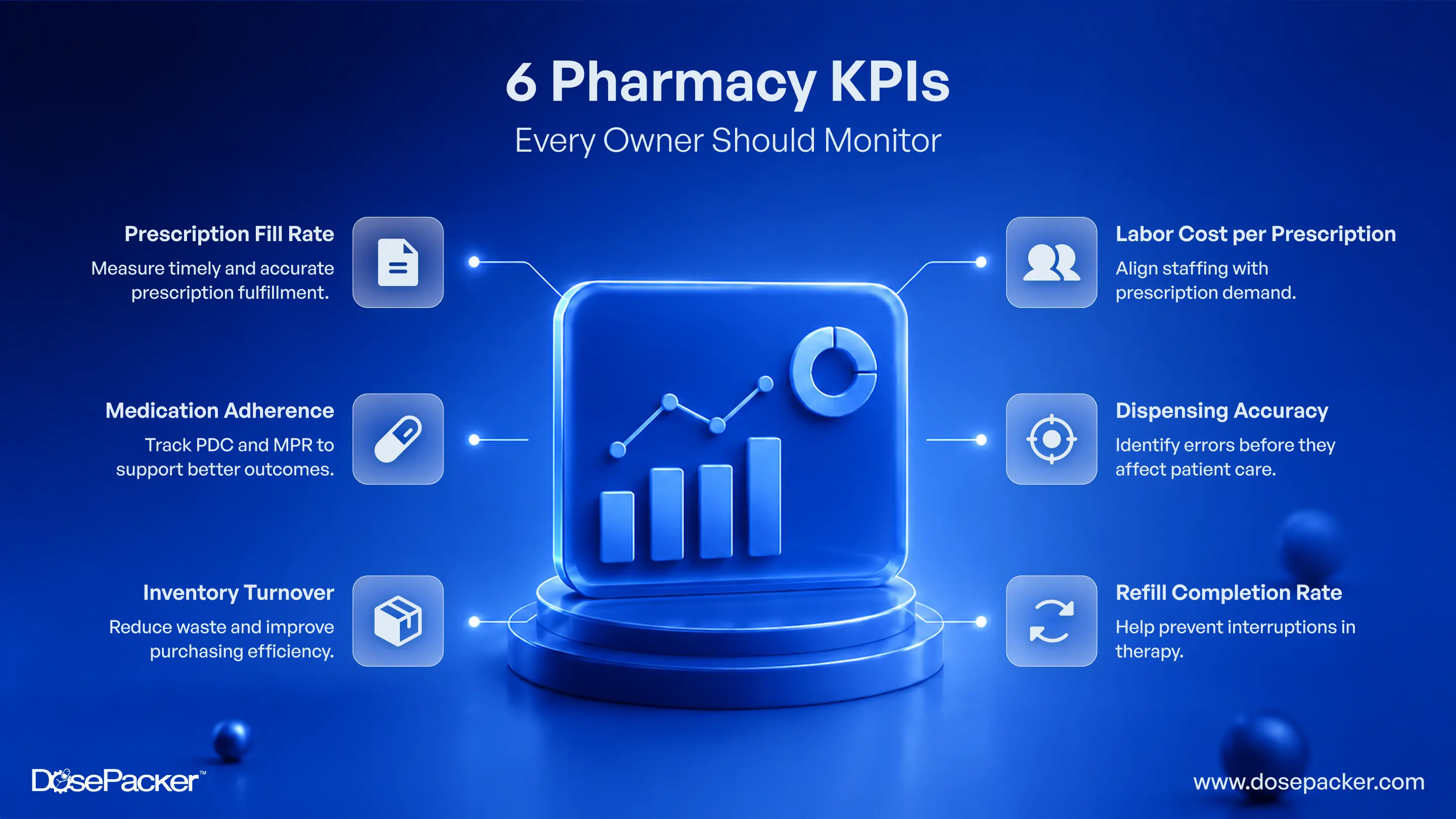
Many operational issues begin long before they appear on financial statements. Tracking the right indicators helps pharmacy owners identify workflow inefficiencies while they are still relatively easy to address.
Prescription volume reflects demand, but demand alone doesn't determine success.
A more useful measure pairs prescription volume with fill rate, the percentage of prescriptions completed accurately and within the expected timeframe. Viewed together, these numbers show whether increasing demand is being supported by efficient workflows or is creating additional strain on pharmacy staff.
Consistently high fill rates also contribute to stronger relationships with providers, care communities, and patients who depend on timely access to medication.
Medication adherence remains one of the most influential indicators of pharmacy performance, particularly in long-term care environments where residents often manage multiple chronic conditions.
Measures such as the Proportion of Days Covered (PDC) and Medication Possession Ratio (MPR) help pharmacies understand whether patients are continuing therapy as prescribed. Improvements in these metrics support better clinical outcomes while strengthening payer performance measures.
Supporting adherence often begins with simplifying medication administration. DosePacker's compliance pack organizes medications into clearly labeled multi-dose packets by the time and date they should be taken, making medication schedules easier for residents and caregivers to follow. When combined with regular adherence monitoring, structured packaging helps pharmacies identify opportunities to improve consistency in medication management.
Inventory is one of a pharmacy's largest operational investments, yet it often receives less attention than prescription volume.
Monitoring inventory turnover helps identify medications that remain on the shelf longer than expected, while shrinkage highlights losses caused by waste, expired products, or dispensing errors. Together, these indicators provide a clearer understanding of purchasing efficiency and inventory control.
Small adjustments to purchasing decisions can improve cash flow, reduce unnecessary carrying costs, and lower the risk of medications expiring before they are dispensed.
Labor represents a significant operating expense for most pharmacies. Tracking labor cost against prescription volume helps determine whether staffing levels align with actual workload.
Unexpected increases don't always indicate overstaffing. They may reflect repetitive manual processes, frequent prescription corrections, or inefficient workflows that consume valuable staff time.
Understanding the reason behind those changes allows pharmacy owners to make operational improvements instead of simply reducing staffing levels.
Operational efficiency keeps a pharmacy running, but clinical performance determines the quality of care delivered every day. Monitoring a few key indicators helps pharmacy owners identify issues before they affect patients, facilities, or payer relationships.
Every dispensing error carries consequences, whether it reaches a patient or is caught during verification. Near-misses deserve the same attention because they often expose weaknesses in the workflow before they become safety events.
Monitoring dispensing accuracy over time helps identify recurring issues such as labeling errors, verification interruptions, or communication gaps between prescribing and dispensing. Looking at trends instead of isolated incidents gives pharmacy leaders a better understanding of where additional training or process improvements are needed.
Patients don't always stop therapy because treatment is no longer needed. Missed refill reminders, delayed authorizations, and communication gaps frequently interrupt medication schedules.
Tracking refill completion rates helps pharmacies identify where those interruptions occur and whether existing follow-up processes are working as expected. When reviewed alongside adherence data, refill activity provides a clearer picture of how consistently patients remain on therapy after the initial prescription is filled.
Collecting reports is easy. Interpreting them consistently is where many pharmacies struggle.
A dashboard showing a 95% fill rate offers only part of the story. What matters is understanding why that number changed. Did delays occur during intake? Was a supplier issue responsible? Did one facility experience a higher volume of exception requests than others?
This is where pharmacy analytics creates value. Instead of reviewing isolated reports from dispensing, billing, inventory, and refill systems, pharmacy owners can identify patterns across the entire operation. Trends become easier to spot, comparisons between facilities become more meaningful, and operational decisions are based on evidence rather than assumptions.
For long-term care pharmacies managing multiple care communities, that visibility is especially valuable. A decline in adherence at one facility or an increase in dispensing corrections at another can be investigated quickly before those trends begin to affect patient care or financial performance.
Many performance issues begin long before they appear on a dashboard.
Repeated data entry, disconnected software platforms, manual refill tracking, and paper-based communication all add time to the dispensing process. Individually, these tasks seem manageable. Together, they create delays that eventually influence fill rates, labor costs, adherence, and inventory performance.
Improving these metrics often starts with improving the workflow itself. Pharmacy automation helps eliminate repetitive manual tasks, improve consistency, and create a stronger foundation for efficient pharmacy operations.
Building on that, implementing pharmacy workflow automation reduces unnecessary handoffs between systems and minimizes repetitive administrative tasks. As prescription processing, dispensing, packaging, and refill management become more connected, staff spend less time managing paperwork and more time supporting patients and care teams.
Tracking KPIs is only valuable when the data reflects what's happening across the pharmacy instead of sitting in disconnected systems. Prescription processing, refill management, medication packaging, and care coordination all influence pharmacy performance, yet they're often managed on separate platforms, making it difficult to see the complete picture.
Connected workflows bring those processes together, giving pharmacy owners greater visibility into day-to-day operations while reducing repetitive administrative tasks. Among the many benefits of pharmacy automation is the ability to standardize routine processes, improve data accuracy, and free pharmacists to spend more time on clinical care instead of manual coordination.
DosePacker supports this approach through an integrated ecosystem designed for long-term care pharmacies. CareCommunityOS centralizes prescription processing and care coordination, DoseKart streamlines refill management and pharmacy operations, and Compliance Pack simplifies medication administration through clearly organized multi-dose packaging.
Working together, these solutions create a connected workflow from prescription intake to medication administration. Instead of reconciling information across multiple systems, pharmacy owners gain meaningful operational insights that improve medication adherence, reduce workflow inefficiencies, and enable more informed decisions through real-time pharmacy analytics.
Every pharmacy is busy. Prescriptions are filled, deliveries leave on schedule, and patients continue to receive care. The challenge isn't keeping the operation moving; it's understanding whether it's becoming more efficient over time.
Tracking the right pharmacy KPIs gives pharmacy owners that perspective. Metrics such as fill rate, medication adherence, inventory turnover, labor costs, and dispensing accuracy reveal operational trends that are easy to miss during a busy workday. When paired with meaningful pharmacy analytics, these insights help identify opportunities to improve workflows, strengthen patient care, and make more informed business decisions.
For long-term care pharmacies, connected technology makes those insights even more valuable. By bringing prescription processing, medication management, refill coordination, and compliance packaging into a single workflow, DosePacker helps transform everyday operational data into measurable improvements across the pharmacy.
Ready to gain greater visibility into your pharmacy's performance?
Contact DosePacker today to learn how our integrated solutions help simplify medication management and support better pharmacy outcomes.
