
Pharmacy automation is revolutionizing medication management by reducing dispensing errors, improving efficiency, and enhancing patient safety. From automated prescription filling to smart DosePacks, discover how automation is transforming modern pharmacy operations.

Picture this: It’s Tuesday afternoon at Community Pharmacy, and Sarah, a seasoned pharmacist, is juggling 200 prescriptions while the phone won’t stop ringing. A patient waits anxiously at the counter, worried about a potential medication interaction. Meanwhile, Sarah spots a labeling error just before a prescription goes out the door. Sound familiar?
This scenario plays out in pharmacies across America every single day. But what if technology could catch that error before Sarah even had to look? What if automation could free her to actually talk with that worried patient instead of racing against the clock?
That’s not a futuristic dream; it’s happening right now in pharmacies embracing automation. Ready to transform your pharmacy workflow?
Here’s a sobering reality: the U.S. Food and Drug Administration receives more than 100,000 suspected drug error reports each year. Even more concerning, medication errors harm at least 7 million people annually, costing the healthcare system billions in additional treatments and lost productivity.
But here’s what those statistics don’t tell you: the pharmacist who can’t sleep at night replaying a near-miss, the elderly patient who can’t keep track of seven different medications, or the care facility struggling with manual documentation for dozens of residents.
The global pharmacy automation market is projected to grow from $6.65 billion in 2024 to a projected $10 billion by 2030 ( CAGR 7.1% ), and it’s not just about impressive numbers. It’s about pharmacies recognizing they can’t manually handle the complexity of modern healthcare anymore.
Think of pharmacy automation as having a tireless, precise assistant who never gets distracted, never misreads handwriting, and never forgets to double-check the dosage.
Modern pharmacy automation encompasses several key technologies:
Inventory management systems track medication stock in real-time, automatically flagging expiring medications and triggering reorders before you run out. No more scrambling to fill prescriptions because you didn’t realize you were down to your last bottle.
Let’s learn if incorporating automation technologies would actually benefit your pharmacy and staff or just create more work for them!
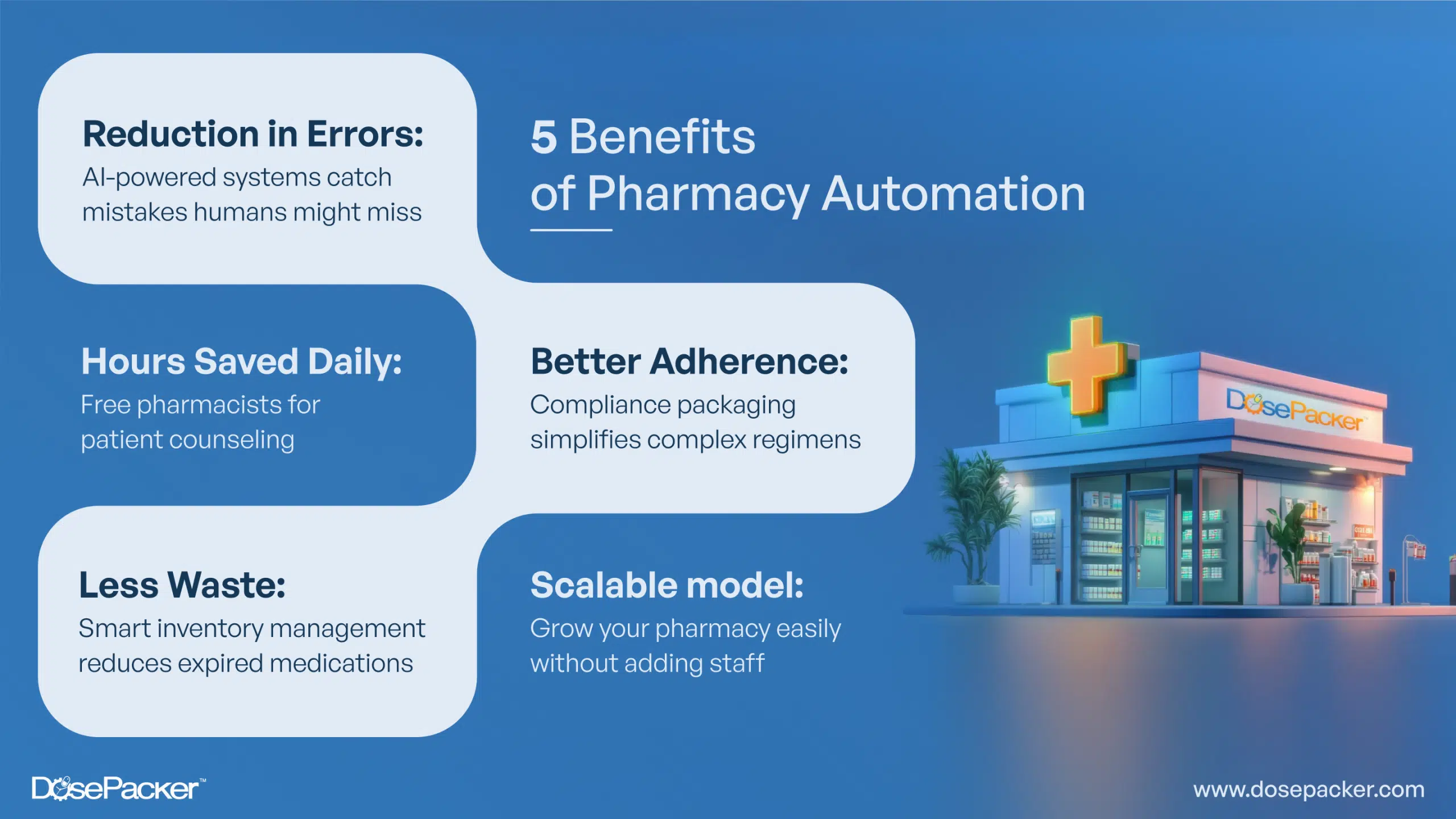
Studies show that nurses and pharmacists identify 30% to 70% of medication-ordering errors, but what about the ones they miss? Automated systems catch errors human eyes might overlook, especially during high-volume periods or at the end of a long shift.
Remember Sarah from our opening? After her pharmacy implemented automation, she discovered something remarkable: she actually had time to counsel patients properly. Instead of racing through prescription checks, she could spend five minutes explaining medication interactions to a diabetic patient managing multiple conditions.
Automated systems handle the repetitive, time-consuming tasks – counting pills, labeling bottles, tracking inventory. This frees pharmacists to do what they trained for: providing clinical expertise and building relationships with patients.
Here’s a challenge every pharmacist knows: getting patients to actually take their medications as prescribed i.e., medication non-adherence. Compliance packaging solves this by organizing medications in easy-to-follow formats.
Instead of seven different bottles with confusing instructions, patients receive clearly labeled DosePacks showing exactly what to take and when. For elderly patients or those managing complex medication regimens, this simple change can be life-transforming.
Dead stock sitting on shelves equals dead money. Automated inventory systems track expiration dates, usage patterns, and optimal stock levels. Beyond reducing waste, automation helps pharmacies optimize their purchasing patterns, negotiate better with suppliers, and reduce the space needed for medication storage. These aren’t small savings; they’re the difference between struggling to stay profitable and thriving in a competitive market.
The United Nations Population Fund predicts people aged 65 and older will grow from 10.3% of the global population in 2024 to 20.7% by 2074. That’s millions more patients needing multiple medications managed carefully over long periods.
Can your current manual processes handle a 100% increase in prescription volume? Automated systems scale easily, add more prescriptions without adding more staff or working longer hours. It’s not about replacing people; it’s about building systems that grow with demand.
“But automation is expensive,” you might be thinking. “We’re a small pharmacy, it’s not for us.”
Here’s a different way to look at it: What’s the cost of not automating?
Calculate the hours spent on manual tasks, the potential liability from dispensing errors, the medications expiring on shelves, and the patients you could serve better with more time.
Most pharmacies find automation pays for itself within 18-24 months through increased efficiency, reduced waste, and the ability to handle higher prescription volumes without adding staff.
Here’s where theory meets reality. DosePacker’s pharmacy automation systems don’t just automate prescription filling, it creates a better experience for everyone involved. Care facilities report fewer medication administration errors, pharmacies process prescriptions faster, and patients find their medications easier to manage.
The pharmacy automation market isn’t growing by accident. It’s expanding at 10.08% annually because pharmacies are discovering that automation isn’t optional anymore; it’s essential for providing safe, efficient, patient-centered care.
The question isn’t whether to automate. It’s a choice between starting now and gaining a competitive advantage, or waiting and struggling to catch up later.
Ready to explore how automation can transform your pharmacy?
Whether you’re a community pharmacy, long-term care facility, or an FQHC, there’s an automation solution that fits your workflow and budget.
Because at the end of the day, automation isn’t about replacing the human touch in pharmacy, it’s about amplifying it. It’s about giving pharmacists like Sarah the time and tools to do what they do best: care for patients.
