
Improper storage can reduce medication effectiveness, increase administration risks, and contribute to medication errors. Learn how to store medications properly and create safer workflows in care communities.

Most people assume their medicine cabinet is doing its job. It holds the pills, it's out of reach of children, and everything is more or less in one place. But here's a number worth sitting with: medication errors affect nearly 1.5 million people every year, and a significant portion of those errors trace back not to the wrong prescription but to improper storage.
Poor storage degrades medications, creates confusion during med-pass, and undermines months of carefully managed treatment plans. Whether you are managing a single resident’s regimen or overseeing medication management for seniors across a 100-bed assisted living community, where and how medications are stored is a foundational piece of safety.
As medication management becomes increasingly complex, many care communities are adopting integrated solutions that combine secure storage, compliance packaging, and digital documentation to reduce risk at every stage of the medication journey. DosePacker’s ecosystem was designed with this goal in mind: helping caregivers maintain safer, more organized medication workflows without adding complexity to their day.
Rethink How Your Care Community Stores Medications
Medication storage cabinet errors rarely happen because someone was careless. They happen because the standard setup- a shared cabinet, a bathroom shelf, a drawer near the nursing station was never designed for the complexity of modern medication management.
In home settings, the medicine cabinet in the bathroom remains the default storage spot for most households, despite being one of the worst possible environments for drug stability. In care facilities, the challenges multiply: dozens of residents, multiple caregivers across rotating shifts, medications with varying storage requirements, and the constant time pressure of a med-pass.
The consequences of getting storage wrong are more serious than many realize. Medications stored in improper conditions lose potency or chemically change. Disorganized systems lead to the wrong pack being pulled. Unsecured storage creates access risks. And when storage isn't integrated with documentation systems, the gap between what was stored and what was administered becomes impossible to track. The hidden costs of medication errors in care facilities go far beyond the clinical, touching legal liability, staff time, and regulatory standing.
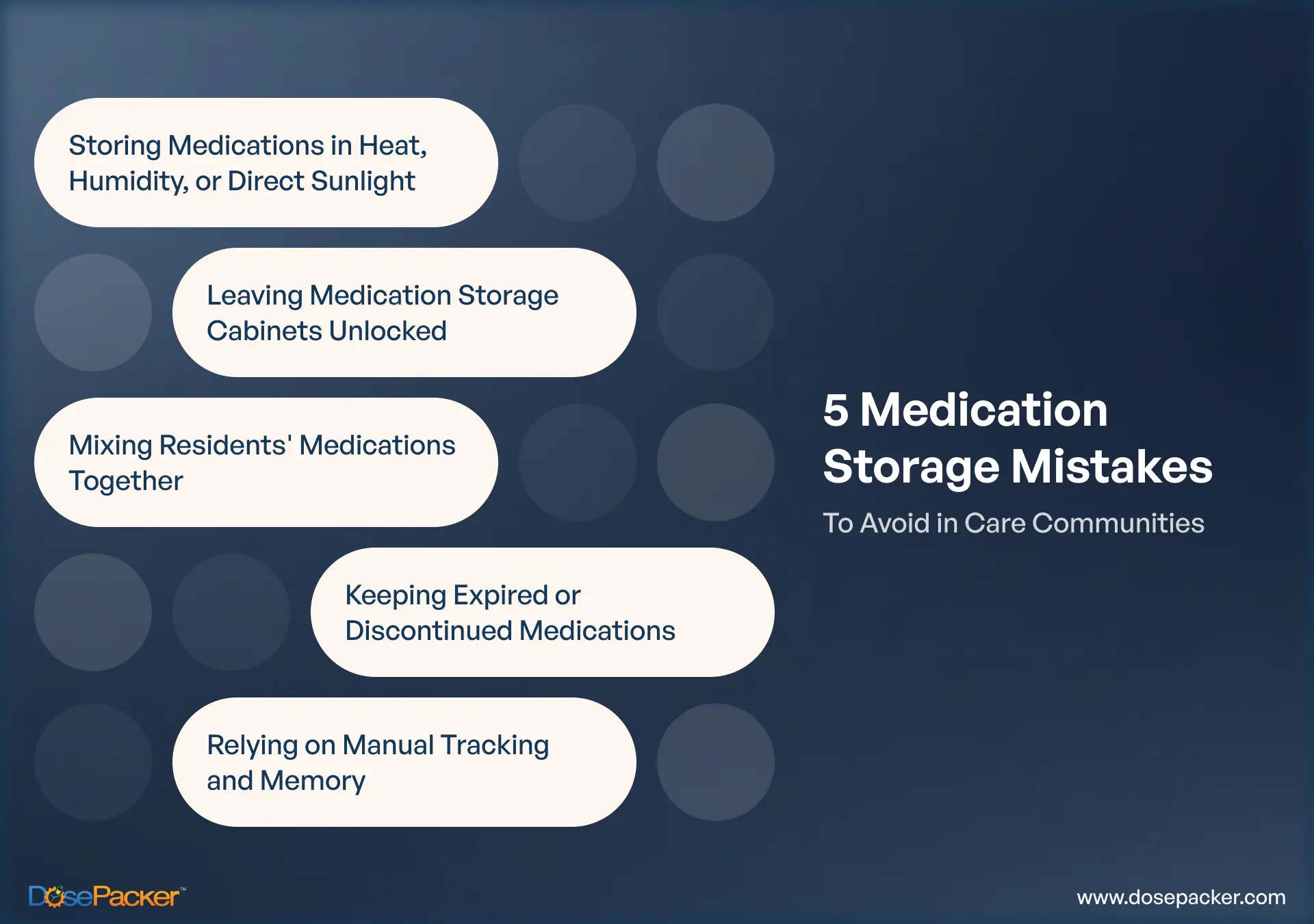
Many medication storage mistakes seem minor at first, but they can have a significant impact on medication safety, caregiver workflows, and resident outcomes. Here are some of the most common mistakes and how to avoid them.
The bathroom medicine cabinet is the most culturally ingrained storage spot for medications, and one of the most damaging. Heat, humidity, and steam from daily showers create exactly the kind of environment that degrades pharmaceuticals fastest.
Most medications should be stored at room temperature between 59°F and 77°F (15°C to 25°C) in a dry place away from direct light. Bathrooms routinely exceed these conditions, often without anyone noticing.
What to do instead:
Windowsills, countertops near stovetops, and car glove compartments are common places medications end up, all exposed to light and temperature swings that break down active ingredients over time.
What to do instead:
When multiple medications for multiple residents share the same space without clear separation and labeling, the conditions for a mix-up are already in place. This is one of the most documented medication storage mistakes in care environments, and reviewing current medication error statistics makes the frequency and cost of these mix-ups difficult to ignore.
What to do instead:
Unlocked cabinets in care communities create access risks. Unauthorized access by visitors, other residents, or staff not assigned to a particular resident can lead to medications being taken, moved, or tampered with. This is a regulatory compliance issue in every care setting.
What to do instead:
Medications that require refrigeration are occasionally stored at room temperature, either because the requirement wasn't communicated clearly at dispensing or because a shared refrigerator became disorganized. Certain insulins, eye drops, and biologics degrade rapidly outside their required temperature range, sometimes within hours.
What to do instead:
Storing expired medications or medications that have been discontinued is one of the most common problems in medication storage cabinets. Expired drugs may be less effective or, in some cases, chemically altered in ways that create unintended effects. Discontinued medications sitting alongside current ones create a genuine risk of accidental administration.
What to do instead:
Handwritten logs, paper-based charts, and memory-dependent processes for tracking what was stored, retrieved, and administered leave too much room for error. During shift handovers, notes get missed. During busy med-passes, documentation gets deferred and then forgotten. The result is a gap between what the records show and what actually happened.
This is one of the central problems with traditional medication storage in care facilities, and it compounds over time.
What to do instead:
Storage that is technically compliant but practically cumbersome creates time pressure during med-passes, and time pressure is one of the most reliable predictors of errors. Caregivers rushing to locate the right pack, navigate a cluttered cabinet, or match a medication to the right resident are caregivers more likely to make a mistake. A structured med-pass checklist helps, but only if the underlying storage system supports efficiency rather than working against it.
What to do instead:
The principles of how to store medications properly apply as much to home settings as they do to care facilities, and the stakes for seniors aging in place are equally real.
Key practices for safe medicine storage for seniors:
For families supporting a loved one in an assisted living setting, asking about the facility's storage system and whether it uses compliance packaging is a legitimate and important question. Medication management for seniors in residential care depends heavily on the quality of the systems in place, not just on the intentions of the staff running them.
There is a meaningful difference between storing medications somewhere compliant and storing them in a system designed around how caregivers work. The latter is what separates facilities that stay organized through a busy med-pass from those that don't.
DosePacker Storage was built specifically for care communities where the margin for error is narrow, and the volume of daily medication activity is high. Rather than asking caregivers to manage organization as a separate mental task, the storage system makes organization automatic.
DosePacker Storage simplifies medication retrieval, improves security, and supports safer medication workflows:
LED-guided retrieval: Green LEDs indicate available slots for incoming packs. When a DosePack is scanned, the correct slot lights up immediately: red confirms verification, and the matching slot illuminates for retrieval. There is no searching, no cross-referencing, no guessing.
Automatic locking: The moment the door closes, it locks. No manual step to remember at the end of a rushed med-pass. No open cabinet left unattended during a busy shift.
Compact and modular: Each unit holds up to 40 DosePacks in an organized, accessible layout. Units stack and share power; no extra cords, no complicated setup, so storage can scale with the size of the community.
Built-in mobility: Four sturdy built-in wheels let caregivers move the unit wherever it's needed throughout the day. Paired with the DoseKart, this mobility extends across larger facilities without disrupting workflow.
Integration with CareCommunityOS: Every scan is logged automatically. Every DosePack movement creates a real-time record. Care teams gain instant visibility into adherence, administration history, and documentation — without any separate data entry step. The storage unit and the digital record stay in sync as a matter of course.
This is what purpose-built storage looks like in practice: not just a place to keep medications safe, but an active part of a workflow that reduces errors at every step. It works as part of the broader DosePacker compliance packaging solution, connecting physical storage to digital documentation across the full arc of medication management.
Medication safety conversations tend to focus on prescribing, dispensing, and administration. Storage sits in the background, assumed to be handled, rarely examined closely until something goes wrong.
Getting storage right doesn't require a complete operational overhaul. It requires treating it with the same seriousness as every other step in the medication management chain, asking whether the current system was built for the volume and complexity it is managing, whether caregivers can work efficiently within it under real-time pressure, and whether the documentation it enables is reliable enough to stand on its own.
The common medication storage mistakes in this guide are common precisely because the standard solutions were never designed to prevent them. The facilities that have moved past them have done so by replacing assumption with intention and building storage systems that make safe practice not just possible, but automatic.
That's where DosePacker helps. Through its integrated medication management ecosystem, care teams can create workflows that are safer, more organized, and easier to manage every day. Because better medication safety doesn't happen by chance; it's built into the systems caregivers rely on.
Ready to Improve Medication Safety in Your Community?
Explore DosePacker Storage and see how smarter storage can support safer resident care.
