



























- The Bigger Picture: Why Retail Pharmacy Is Changing Fast
- Trend 1: Compliance Packaging Is Becoming the Standard, Not the Exception
- Trend 2: Technology-Enabled Medication Reminders Are Replacing Passive Systems
- Trend 3: The Pharmacy's Role in Care Coordination Is Expanding
- Trend 4: Automation Is Reducing Errors and Freeing Pharmacists for Clinical Work
- Trend 5: Interoperability Is Connecting Pharmacy Data to the Broader Care Ecosystem
- Trend 6: Patient-Centered Design Is Becoming a Competitive Differentiator
- Trend 7: Value-Based Care Is Reshaping How Pharmacies Are Rewarded
- Trend 8: Medication Synchronization Is Closing a Quiet but Costly Adherence Gap
- What These Trends Mean for Your Pharmacy or Care Community
- FAQs
Unlock the latest in medication management technology and grow your care community with us.

Picture a neighborhood pharmacy from a decade ago. A pharmacist behind a tall counter, rows of pill bottles, a printer spitting out paper bags, and a phone ringing off the hook with refill requests. Now picture what that same pharmacy looks like today: automated dispensing, real-time adherence dashboards, connected apps, smart compliance packaging, and care coordinators following up on missed doses before patients even reach out.
Retail pharmacy is no longer simply about dispensing medications. It has become one of the most important touchpoints in the broader healthcare continuum, and the trends shaping this evolution have profound implications for pharmacists, care communities, and the patients they serve every day.
The numbers make the stakes clear. The US retail pharmacy market is estimated to reach $670.6 billion in 2025 and is projected to grow to $901.4 billion by 2032, expanding at a CAGR of 4.3%. That kind of sustained growth reflects a sector that is not just scaling in volume but transforming in scope, moving from a transactional dispensing model towards an integrated care delivery model that touches every part of a patient’s health journey.
Understanding where the retail pharmacy industry is heading and aligning your medication management strategy accordingly is crucial. It is the difference between staying relevant and falling behind.
This guide walks through the most significant retail pharmacy trends redefining the industry in 2026 and explains how forward-thinking pharmacies and care communities are responding.
Ready to align with where retail pharmacy is heading?
The Bigger Picture: Why Retail Pharmacy Is Changing Fast
Before diving into specific retail pharmacy trends, it helps to understand the macro forces accelerating this transformation.
Every Baby Boomer is now over 60, and the oldest are well into their 80s, creating unprecedented demand for chronic disease management, polypharmacy support, and long-term care coordination. The healthcare system is simultaneously under enormous pressure to reduce preventable hospitalizations and lower costs. Medication non-adherence costs the US healthcare system an estimated $300 billion annually, making it one of the highest-priority targets for intervention across payers, providers, and pharmacy networks alike.
Patient expectations have also shifted. People who track packages in real time and manage their finances on a smartphone are no longer willing to accept a pharmacy experience that requires manual refill calls, long waits, and no follow-up to confirm whether a dose was taken.
These converging forces are driving retail pharmacy industry trends that touch every part of the medication management journey, from the pharmacy counter to the patient’s bedside. The pharmacies and care settings that recognize these shifts early will be best positioned to serve patients well and operate sustainably in the years ahead. Here is where the industry is moving, and what it means for how medication management needs to work.
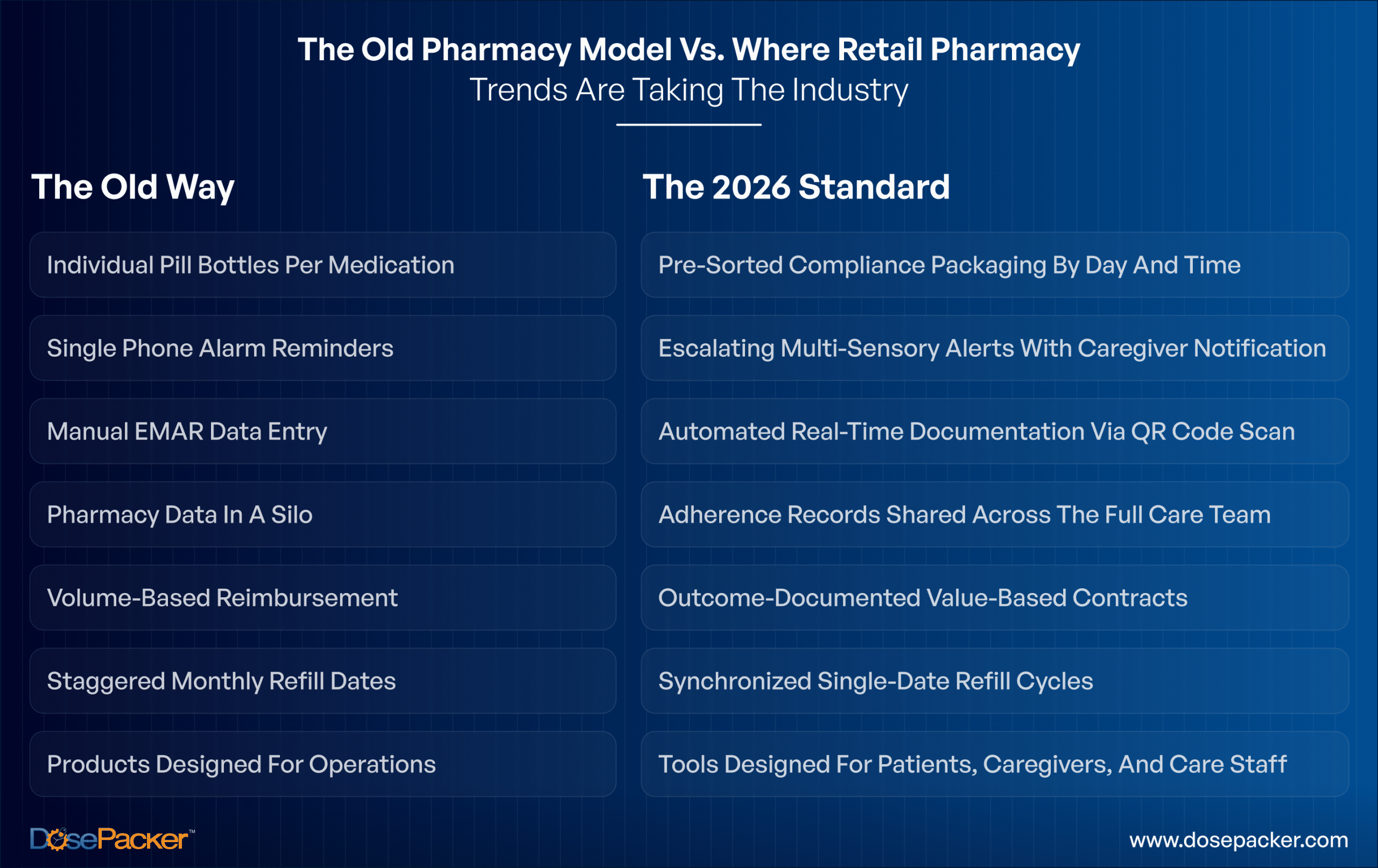
Which column describes your pharmacy today?
Trend 1: Compliance Packaging Is Becoming the Standard, Not the Exception
Walk into any high-performing pharmacy or care community today, and you will find compliance packaging at the center of their medication management workflow. Rather than filling individual bottles for each drug, pharmacies use compliance packaging to pre-sort a patient’s entire medication regimen into clearly labeled dose cups or strip packs organized by day and time. This is no longer a niche offering. It is rapidly becoming the baseline expectation for anyone managing more than two or three medications.
The reason this retail pharmacy trend has gained so much momentum is straightforward. Research shows that more than 4 in 10 seniors take 5 or more prescription medications at once. Each comes with its own dosing schedule, food interaction, and refill timeline. Managing all of that mentally, day after day, is genuinely unrealistic, regardless of how motivated or attentive a patient may be.
Compliance packaging removes that cognitive burden entirely. Pre-sorted, clearly labeled dose cups organized by day and time eliminate the guesswork, reduce the risk of double-dosing or skipping, and give patients and their families a simple, visual way to track whether each dose has been taken.
The most important nuance here is that packaging alone is not the full answer. A dose cup sitting on a counter is still a missed dose if no reminder arrives, and a reminder without the correct medication in front of the patient is still an incomplete solution. The retail pharmacy trend toward compliance packaging is most powerful when it is embedded within a broader ecosystem of reminders, tracking, and caregiver connectivity, which brings us to the next major shift.
Trend 2: Technology-Enabled Medication Reminders Are Replacing Passive Systems
The basic phone alarm as a medication reminder is being left behind. In its place, one of the most rapidly evolving retail pharmacy industry trends in 2026 is the rise of connected, closed-loop reminder systems that not only alert patients but also verify the dose, notify caregivers, and automatically document everything.
Modern systems escalate alerts if a dose goes unacknowledged. They push real-time notifications to family members or care staff when a dose is missed. They log adherence data and surface it for providers at the point of care. And the best ones connect directly to the physical medication packaging, so the reminder and the correct dose are always presented together as one seamless experience.
This is exactly the gap that DosePacker’s DoseMinder is designed to close. It is a smart medication storage device that syncs with the MyDoses app to deliver audio-visual alerts designed specifically for older adults, loud enough to be heard, visible enough to be noticed, and simple enough to act on without confusion. Its standout feature is video confirmation: when a patient opens the device and takes their dose, DoseMinder records that moment. For distant family members, that confirmation is genuine peace of mind. For care providers, it is a documentation record that no self-reporting system can replicate.
The MyDoses app extends this further by delivering timely reminders that escalate if ignored, notifying care teams when doses are missed, and maintaining a running adherence history that healthcare providers can review at any point.
Trend 3: The Pharmacy’s Role in Care Coordination Is Expanding
One of the most structurally significant trends in retail pharmacy today is the dismantling of the purely transactional pharmacy model. A prescription filled and handed over is no longer the end of the interaction. Pharmacists are becoming active participants in care coordination, and the infrastructure to support that role is finally catching up with the clinical potential they have always had.
Pharmacists carry clinical training that positions them to identify drug interactions, counsel patients on adherence barriers, flag concerning patterns, and communicate proactively with prescribers. What they have historically lacked is the data infrastructure to do this efficiently and consistently across a large patient population.
For retail pharmacies serving assisted living facilities, home health agencies, or PACE programs, this retail pharmacy industry trend creates a meaningful opportunity. The pharmacies that invest in platforms connecting their dispensing data directly to care team workflows will be far better positioned to serve these high-value settings than those still relying on phone calls and fax machines. The conversation is shifting from “did we fill the prescription?” to “is the patient benefiting from it?” and pharmacies that can answer the second question will have a significant competitive advantage.
Trend 4: Automation Is Reducing Errors and Freeing Pharmacists for Clinical Work
Automation has been a consistent thread in retail pharmacy industry trends for several years, but 2026 is seeing meaningful acceleration. Rising prescription volumes, ongoing staffing challenges, and growing pressure to reduce dispensing errors are all pushing pharmacies toward automated dispensing technology, barcode verification, and digital workflow management.
The operational benefits are: faster fill times, fewer errors, and less waste. But the strategic benefit is even more significant. Every task that automation handles is a task that no longer pulls a pharmacist away from clinical consultation, adherence counseling, and proactive patient outreach, the activities that truly drive health outcomes and patient loyalty.
DosePacker supports this shift through the MyDoses app’s QR code-based dose verification system. Each DosePack dose cup carries a QR code that care teams or patients scan to confirm the correct medication at the correct time. The scan simultaneously verifies the dose and automates eMAR documentation in real time, eliminating all manual data entry. For high-volume care settings, this built-in verification represents a meaningful upgrade in both safety and operational efficiency, without adding steps to the caregiver’s existing workflow.
Trend 5: Interoperability Is Connecting Pharmacy Data to the Broader Care Ecosystem
Retail pharmacy has historically operated in a data silo. Prescription records were stored in pharmacy management systems and rarely flowed to electronic health records or to the clinical teams making daily care decisions. Breaking down that silo is one of the most consequential retail pharmacy trends of 2026, and pharmacies that move quickly on this are gaining a real edge.
When a physician can review a patient’s 30-day adherence history before an appointment, clinical decisions improve. When a care coordinator is automatically alerted that a resident has missed three consecutive doses, intervention occurs before hospitalization. These outcomes are only possible when pharmacy data is accessible, accurate, and actionable in real time, which requires an intentional platform rather than bolt-on reporting tools.
The broader direction of the retail pharmacy industry is clear: siloed systems will give way to connected platforms that share data in real time across the care team. Pharmacies that build interoperability into their medication management infrastructure now will be well ahead of regulatory and payer expectations as value-based care models mature.
Trend 6: Patient-Centered Design Is Becoming a Competitive Differentiator
For years, pharmacy products were designed around operational efficiency. How many prescriptions can we fill per hour with the fewest errors? That framing is giving way to a newer and increasingly prominent retail pharmacy trend: patient-centered design, building tools and services around the real-world needs, capabilities, and daily realities of the people who use them.
For older adults, this means packaging that is genuinely easy to open, reminder systems that account for hearing and vision changes, and app interfaces that require no technical sophistication to navigate. For family caregivers, it means visibility into adherence without making daily phone calls. For care staff, it means documentation that flows naturally from the care workflow rather than being added on as a separate administrative burden.
DosePacker has built its entire ecosystem around this philosophy. In a market where most tools are built for the operations team, DosePacker builds for the patient, the caregiver, and the family.
Trend 7: Value-Based Care Is Reshaping How Pharmacies Are Rewarded
The most structural of all current retail pharmacy industry trends is the ongoing and accelerating shift toward value-based care. Rather than paying for the volume of prescriptions filled, value-based models tie reimbursement to measurable patient outcomes. For retail pharmacy, this creates both real pressure and a significant opportunity.
The pressure: dispensing-based revenue alone is increasingly difficult to sustain as reimbursement rates tighten and competition intensifies. The opportunity: pharmacies that can demonstrate measurable impact on adherence rates, readmission reduction, and chronic disease management are gaining access to value-based contracts, shared savings arrangements, and enhanced services programs, representing an entirely new and growing revenue stream.
Capturing that opportunity requires documentation. Time-stamped adherence records, confirmed dose logs, caregiver notification histories, and care coordination data that collectively tell the story of how a patient’s medication regimen is being managed in practice. This is where DosePacker’s ecosystem delivers particular value. Its platform generates this documentation as a natural byproduct of the daily care workflow, not as a separate reporting exercise. Pharmacies and care communities that can walk into a contracting conversation with this kind of evidence will have a distinct and growing advantage as the value-based care model matures.
Trend 8: Medication Synchronization Is Closing a Quiet but Costly Adherence Gap
A retail pharmacy trend that has quietly grown into a mainstream expectation is medication synchronization: aligning all of a patient’s prescription refills with a single monthly pickup or delivery date. For patients managing multiple medications with staggered refill timelines, this is a deceptively significant change. Running out of a critical medication because its refill date fell in an inconvenient week is one of the most common and preventable causes of non-adherence, and synchronization eliminates it entirely.
From an operations standpoint, med sync creates a predictable workflow, reduces emergency fills, and transforms the monthly refill into a meaningful care touchpoint rather than a rushed, forgettable errand. It also creates a natural rhythm for compliance packaging, where a full month’s worth of pre-sorted doses can be prepared and delivered in one cycle.
The pharmacies and care communities that treat medication synchronization as a standard offering rather than a premium add-on are seeing measurable improvements in adherence and patient retention. As trends in retail pharmacy continue to reward demonstrated outcomes, med sync deserves to be treated as a foundational element of any adherence strategy rather than an optional service.
What These Trends Mean for Your Pharmacy or Care Community
The retail pharmacy trends shaping 2026 are not isolated developments. They are interconnected signals pointing in the same direction: toward a more integrated, more data-driven, more patient-centered, and a more accountable model for pharmacy care than anything that came before it.
Responding to these trends does not require overhauling your entire operation at once. It requires identifying where your current medication management workflow has gaps and filling them with solutions built for where pharmacy care is heading.
DosePacker’s medication management solutions are designed precisely for this moment. Whether you are a pharmacy looking to differentiate, a care community working to reduce medication errors, or a home health agency trying to better support complex patients between visits, DosePacker offers a connected, scalable approach that aligns with every major retail pharmacy industry trend in play today.
The pharmacies and care settings leading the industry in the years ahead will be the ones making smart, strategic choices now. And every trend points to the same conclusion: connected, documented, patient-centered medication management is no longer optional. It is the standard!
FAQs
The biggest trends include compliance packaging, technology-enabled reminders, expanded pharmacist roles in care coordination, automation, interoperability, patient-centered design, value-based reimbursement, and medication synchronization. Together, they are reshaping how pharmacies deliver and document care.
Today’s retail pharmacy trends create end-to-end adherence infrastructure: pre-sorted packaging removes guesswork, smart reminders escalate if doses are missed, and real-time tracking gives care teams the visibility to intervene early rather than reactively.
Yes. Many of the most impactful trends, including compliance packaging, medication synchronization, and connected reminder tools, are accessible without large capital investment. The key is choosing solutions that scale to the size and needs of your specific care setting.



 Facebook
 WhatsApp
 Instagram
 Twitter
 Gmail
Gmail
 LinkedIn
