




























- Why the Right Partner Matters as Much as the Platform
- 1. Depth of Integration with Your Existing Workflows
- 2. Medication Safety Architecture
- 3. Medication Adherence Support Beyond Dispensing
- 4. Implementation Support and Training
- 5. Ongoing Support, Updates, and Partnership Evolution
- 6. Scalability for Your Growth Trajectory
- Choose a Pharmacy Automation Partner That Works the Way You Do
- FAQs
Unlock the latest in medication management technology and grow your care community with us.

The pharmacy industry is under pressure that only seems to increase year over year. Staffing shortages, rising patient complexity, tighter margins, and expanding regulatory demands have pushed medication management to a breaking point for many facilities. Pharmacy automation has emerged as the most viable solution, and the clinical evidence supports it.
Research on the adoption of automated dispensing systems found that dispensing errors fell from 3.87 to 0 per 100,000 dispensations, and the most serious medication error categories dropped by up to 75%. These are not incremental improvements; they are transformational outcomes that directly protect patient lives.
But here is what that data cannot tell you: those results only materialize when the right system is implemented by the right partner, in the right way.
Choosing a pharmacy automation partner is one of the highest-stakes decisions a pharmacy director or care administrator will make. The right partner will streamline your workflows, reduce errors, support regulatory compliance, and scale with your facility as it grows.
At DosePacker, we’ve worked with long-term care communities, assisted living facilities, and dispensing pharmacies nationwide. We’ve seen firsthand what separates a successful automation partnership from a costly one. This guide covers the six factors that should drive your evaluation, so you can make a decision you won’t have to revisit in eighteen months.
Why the Right Partner Matters as Much as the Platform
It is tempting to evaluate pharmacy automation purely based on technology specs. Can the system handle your volume? Does it integrate with your pharmacy management software? How accurate is the dispensing mechanism? These are all important questions, but they only tell part of the story.
What technology specs cannot tell you is whether the company behind the system will still be responsive six months after installation, whether their implementation team understands the specific regulatory environment of long-term care, or whether their software roadmap aligns with the direction your facility is heading. These are partnership questions, and they tend to matter most after the contract is signed.
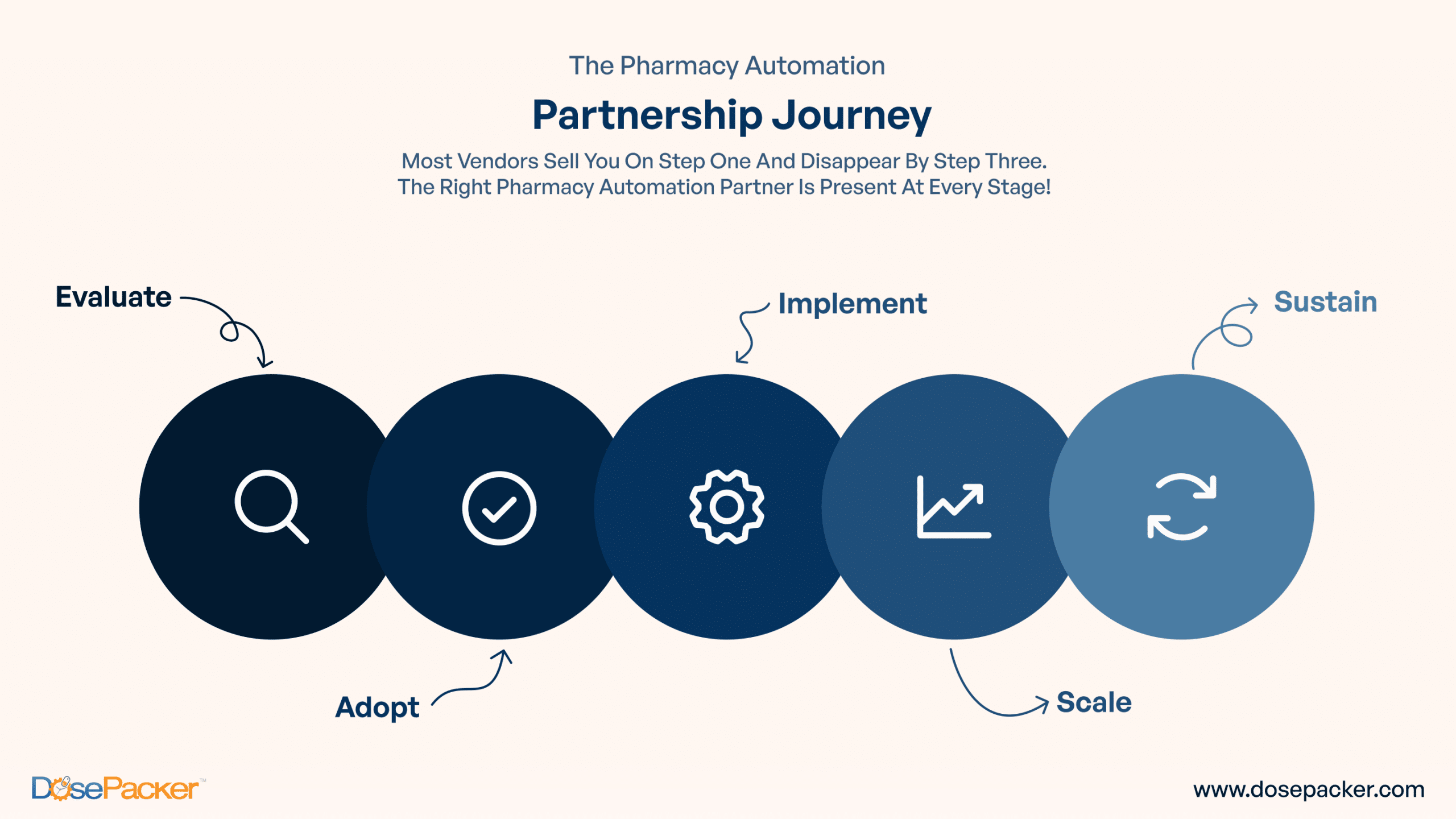
Here are the six factors that separate the ones worth trusting from the ones worth walking away from.
1. Depth of Integration with Your Existing Workflows
One of the most common and costly mistakes facilities make when choosing a pharmacy automation partner is assuming that integration is a checkbox rather than a process. Every pharmacy already operates within a web of existing systems: pharmacy management software, electronic health records, eMAR platforms, and care coordination tools. True integration means your automation solution communicates seamlessly with all of these in real time, bidirectionally, and without manual workarounds.
Before evaluating any automation partner, map out every system your pharmacy and care team currently relies on.
A strong pharmacy automation partner will have a proven track record of integration and the technical capacity to adapt as systems around them change. A weak one will offer a list of “supported” integrations without explaining how those integrations actually function in a live facility environment.
DosePacker’s ecosystem is built with integration as a foundational principle. The platform is designed to slot into how care teams already work, reducing the adoption friction that can stall even well-resourced implementations.
2. Medication Safety Architecture
The core promise of pharmacy automation is safer medication delivery. The benefits of pharmacy automation include reduced dispensing errors, improved medication reconciliation, and better adherence documentation, but only when the system is architected with safety as its organizing principle.
When evaluating any pharmacy automation partner, examine the specific safety mechanisms built into their system. Questions to ask include:
- How does the system verify that the correct medication is dispensed to the correct patient at the correct time?
- What happens when a medication is recalled or when a patient’s prescription changes mid-cycle?
- How does the system handle PRN medications or medications with complex administration instructions?
- What audit trail does the system generate, and how is that documentation structured for compliance purposes?
Look beyond error-rate statistics and ask to see the actual safety workflow in action. A partner that can walk you through these scenarios with clarity and confidence is one whose safety architecture has been stress-tested in real-world environments.
3. Medication Adherence Support Beyond Dispensing
The most meaningful measure of a system’s impact is whether it improves patient outcomes, and that requires robust medication adherence tools that extend the system’s reach from the pharmacy counter to the point of care and beyond.
Ask any potential pharmacy automation partner how their system supports adherence, not just at dispensing, but throughout the full medication lifecycle.
For care communities in particular, adherence documentation is also a compliance requirement. A pharmacy automation partner whose system generates clean, defensible adherence records is providing value that extends well beyond clinical outcomes into regulatory risk management.
4. Implementation Support and Training
Even the most sophisticated pharmacy automation system will fail if implementation is rushed, training is inadequate, or go-live support evaporates once the contract is signed. This is one of the most common points of failure in pharmacy automation deployments, and it is entirely predictable. This means that it is also entirely preventable if you know what to look for.
When evaluating a potential pharmacy automation partner, ask for a detailed implementation timeline and methodology.
Strong partners will have a structured, tested implementation process with clear milestones and accountability checkpoints. Weak partners will offer vague timelines and reassurances without specifics. The difference becomes very apparent when you ask for references and specifically ask them about their implementation experience.
5. Ongoing Support, Updates, and Partnership Evolution
A pharmacy automation partner’s value does not peak at the implementation stage. It should compound over time as the system matures, as your facility’s needs evolve, and as the regulatory and clinical landscape continues to shift.
Evaluate how a potential partner handles ongoing support. Also, evaluate the partner’s product roadmap.
The best pharmacy automation partner sees your success as central to their own, not as a sale that has already closed. Ask how many of their current customers have been with them for five or more years. Retention is the most honest signal of partnership quality!
6. Scalability for Your Growth Trajectory
Your facility may look quite different in three years. New care settings and evolving care models all create demands your pharmacy automation system must accommodate.
When choosing a pharmacy automation partner, evaluate not just how well their solution meets your current needs, but how confidently it can scale with your growth.
A partner whose platform is architected for scalability will have clear answers to these questions and will be able to show you live examples. A partner whose platform has undisclosed limitations will redirect the conversation toward current-state capabilities rather than future-state confidence.
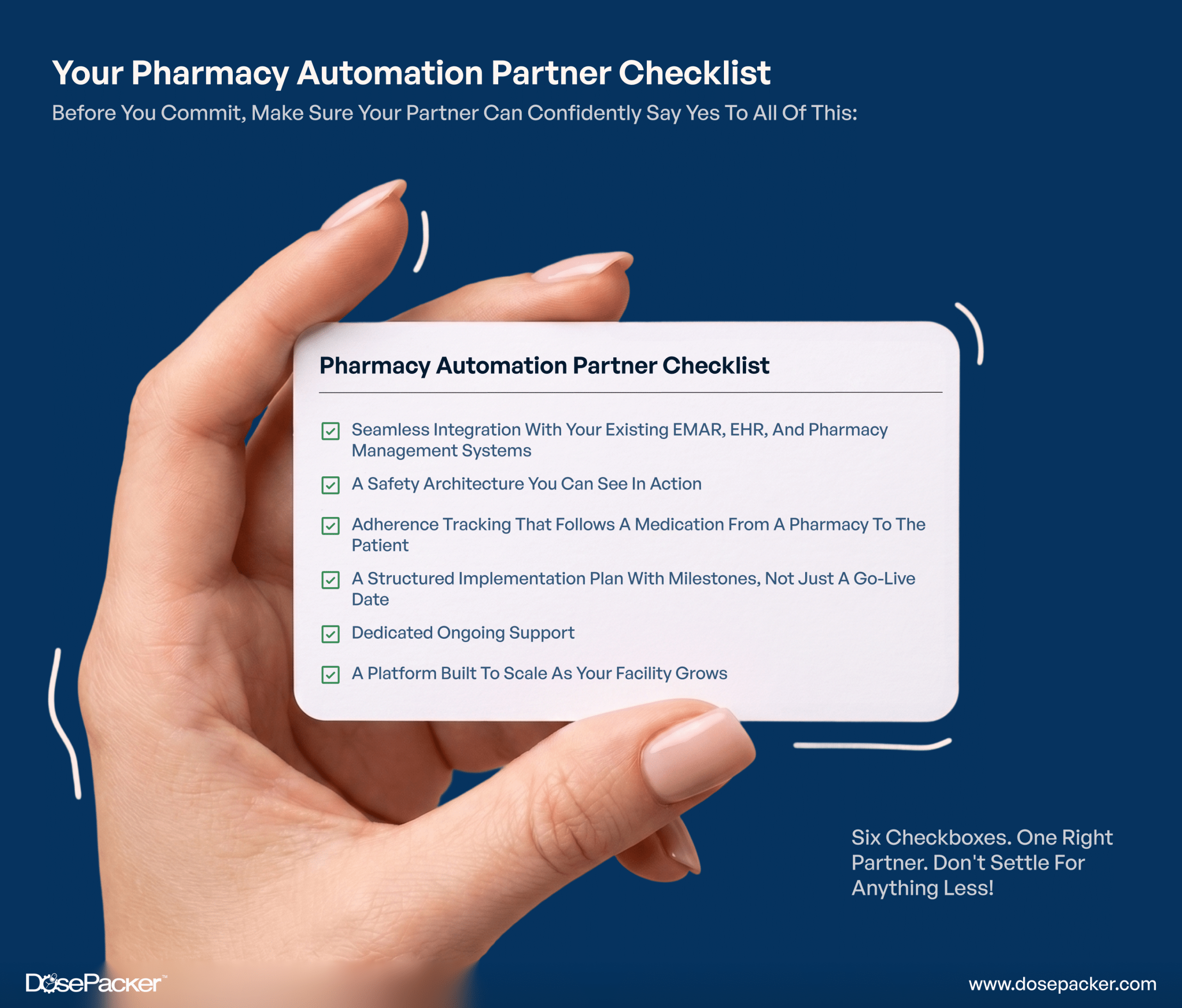
Choose a Pharmacy Automation Partner That Works the Way You Do
There is no shortage of pharmacy automation vendors in the market today. What is genuinely scarce is a pharmacy automation partner whose technology, implementation approach, ongoing support model, and clinical philosophy align with the specific way your team works and the specific patients you serve.
At DosePacker, we have built our platform specifically for the long-term care environment, where medication management is a direct determinant of resident health outcomes. Our integrated ecosystem was designed to eliminate the gaps that other systems leave open: between the pharmacy and the care, between dispensing and administration.
Explore how our integrated automation ecosystem can be configured for your facility’s specific needs, scale, and care model.
FAQs
While technology capabilities matter significantly, the most important factor is the depth and quality of the partnership itself. This includes the partner’s implementation methodology, responsiveness to ongoing support, and regulatory expertise in your care setting. Plus a demonstrated commitment to your long-term success.
Implementation timelines vary based on facility size, system complexity, and the extent of integration required with existing platforms. For long-term care communities, full implementation, including training and go-live support, typically takes six to twelve weeks. Be cautious of partners who offer dramatically shorter timelines without a clear explanation of how they achieve them without cutting corners on training or integration quality.
Request data on dispensing accuracy rates across comparable facilities, ask about their error-detection mechanisms and escalation workflows, and speak directly with reference customers about their safety experience. Also, ask how the partner handles medication recalls, mid-cycle prescription changes, and compliance documentation in the event of a survey.



 Facebook
 WhatsApp
 Instagram
 Twitter
 Gmail
Gmail
 LinkedIn
