




























- Why Prescription Packaging Mistakes Matter More in Care Settings
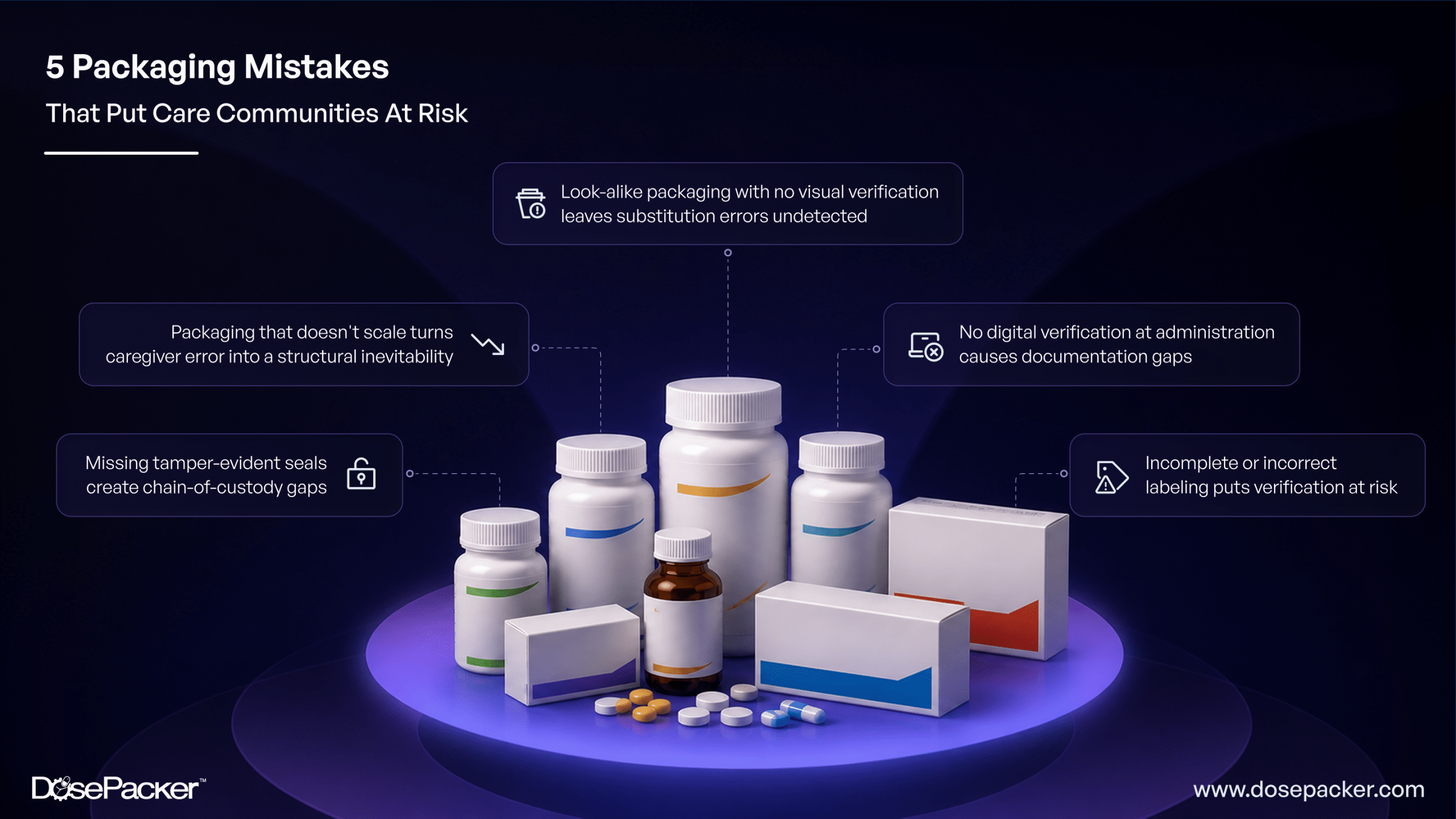
- Mistake #1: Incorrect or Incomplete Labeling
- Mistake #2: Missing or Compromised Tamper-Evident Seals
- Mistake #3: Wrong Medication in the Right-Looking Package
- Mistake #4: No Digital Verification at the Point of Administration
- Mistake #5: Packaging That Does Not Scale With the Care Environment
- The Common Thread Behind Every Prescription Packaging Mistake
- FAQs
Unlock the latest in medication management technology and grow your care community with us.

Every care community has systems in place to catch medication errors, clinical protocols, caregiver training, and documentation checklists. What most of those systems do not account for is the packaging those medications arrive in.
Research has shown that up to 33% of all medication errors are attributed to packaging and labeling confusion, and yet prescription packaging mistakes remain among the least scrutinized aspects of medication safety in care settings.
This guide breaks down the five most common prescription packaging mistakes in the pharma industry, why they happen, and how DosePacker’s compliance packaging is designed to close these gaps.
Why Prescription Packaging Mistakes Matter More in Care Settings
In a retail pharmacy, a prescription packaging mistake affects one patient. In a care community, the same mistake can move through multiple residents across multiple med-passes before anyone catches it.
The consequences extend well beyond the immediate safety risk. Packaging mistakes in the pharma industry trigger:
- Regulatory findings during medication management surveys
- DEA scrutiny around controlled substance handling
- CMS compliance violations
- Civil liability in cases where a packaging error results in demonstrable resident harm
And unlike many clinical errors, a prescription packaging mistake is almost always traceable, which means it is almost always documentable, and therefore almost always preventable. The five mistakes below are the most consistently identified in care community audits, pharmacy surveys, and FDA recall records.
Mistake #1: Incorrect or Incomplete Labeling
Of all the prescription packaging mistakes in the pharma industry, incorrect labeling carries the most regulatory weight and is most often dismissed as a minor administrative issue until something goes wrong.
Why does it happen?
A medication label missing a resident’s full name, the correct dosing time, the prescribing physician’s information, or the medication’s generic name is not just incomplete; it is non-compliant. The risk compounds in settings with:
- High staff turnover or frequent use of agency caregivers
- Manual labeling processes with no built-in verification step
- High resident volume across multiple daily med-passes
A long-tenured nurse can compensate for a weak label through familiarity. A relief caregiver cannot and should not have to.
Why does it matter?
Labeling errors are the most common reason for drug recalls from a packaging standpoint, according to FDA recall data. In care settings, they are also among the most frequently cited findings during medication management surveys, precisely because they are visible, auditable, and directly tied to the physical packaging moving through the environment every single day.
DosePacker addresses this by printing every compliance pack with the resident’s full name, medication name, dose, dosing time, and a high-resolution image of the pill itself, so the label does the verification work, not the caregiver’s memory.
Mistake #2: Missing or Compromised Tamper-Evident Seals
A medication pack that arrives without a tamper-evident seal, or one that has been broken without documentation, is a compliance problem waiting to surface. And yet this is one of the prescription packaging mistakes that care communities most consistently miss, because it does not register as an error unless someone is specifically trained to look for it.
Why it matters
Tamper-evident packaging serves two distinct purposes:
- Resident safety: It protects against medications that may have been accessed, altered, or substituted between dispensing and administration
- Liability protection: It gives care communities a defensible, documented chain of custody from the pharmacy to the point of care
Without it, the documentation trail has a gap that no after-the-fact paperwork can fill. Pharmaceutical manufacturers are responsible for the integrity of their entire distribution chain, and, in care settings, that responsibility extends to the packaging that arrives in the medication room. A broken or missing seal is not just a technicality. It is an auditable gap.
Mistake #3: Wrong Medication in the Right-Looking Package
This is the prescription packaging mistake in the pharma industry that is least common and most consequential. Medications that look similar, carry similar names, or arrive in visually indistinguishable packaging are a documented source of medication errors in care settings, and the window to catch them is small.
Where the risk is highest
The problem is most acute in communities still relying on traditional vial-based dispensing, where caregivers sort and pour individual doses during the med-pass. In that workflow:
- Every pour is a potential error point
- Every generically labeled vial is a verification gap
- There is no reliable way to catch a substitution error without cross-referencing the physical pill against a separate reference: a step most med-pass workflows do not build time for
How does DosePacker’s compliance packaging change the equation?
Every DosePack includes a high-resolution image of the actual pill on every dose label, giving caregivers a visual confirmation point before the pack is opened. Color-coded dose cups by administration time: green for morning, red for noon, yellow for evening, blue for bedtime. This adds a second layer of verification that generic packaging simply cannot replicate.
Mistake #4: No Digital Verification at the Point of Administration
One of the most significant packaging mistakes in the pharma industry is not about the physical packaging at all; it is about what happens the moment it is opened, and nothing records it.
The documentation gap
Care communities relying on paper MARs or end-of-shift manual documentation face a consistent problem: there is an inevitable gap between what happened during the med-pass and what gets written down afterward.
- Doses that were given get missed in documentation
- Doses that were not given get checked off from memory
- The physical packaging tells half the story; the documentation is supposed to tell the other half
When the two do not align, survey findings, compliance violations, and liability exposure surface. Digital verification at the point of administration is the difference between a defensible record and an auditable gap!
How it works with DosePack
Every DosePack compliance pack includes a QR code that can be scanned. When a caregiver scans it using the MyDoses app:
- The app confirms the correct medication
- The administration is logged in real time
- The electronic medication administration record is updated automatically: no manual entry, no end-of-shift documentation from memory
Tamper evidence becomes a documented, time-stamped, digitally verified event every single time!
Mistake #5: Packaging That Does Not Scale With the Care Environment
The final prescription packaging mistake in the pharma industry is a structural one, and it is the one that makes every other mistake harder to prevent.
The core problem
When care communities rely on packaging systems that were not designed for their environment: traditional vials, generic blister packs, and manually sorted unit-dose trays, the burden of accuracy falls entirely on the caregiver. The result:
- Packaging that does not carry enough information to be verified correctly
- Storage that does not connect to the administration record
- Documentation trails that are manual and therefore exposed to the same human error that the packaging was supposed to prevent
Prescription packaging mistakes do not just happen because caregivers make errors. They happen because the systems around caregivers create conditions for errors. A packaging system that works for ten residents but breaks down at thirty is a liability that grows with the community it serves.
What a scalable system looks like
DosePack is built as part of a connected ecosystem, integrating directly with CareCommunityOS, DosePacker Storage, and the MyDoses app to create a complete workflow from dispensing through administration through documentation. Whether a community manages 10 residents or 100, the verification process, documentation trail, and dose-level accuracy stay consistent.
With over 560,000 compliance packs delivered and more than 350 care communities served, we believe in that consistency as a standard!
The Common Thread Behind Every Prescription Packaging Mistake
Looking across all five prescription packaging mistakes, one pattern is clear: they are almost never the result of carelessness. They are the result of systems that place too much responsibility on individual caregivers in high-pressure, high-volume workflows, without the right tools to bank on.
Packaging mistakes in the pharma industry are avoidable. What makes them avoidable is not more training or more checklists. It is a packaging designed to catch errors before they happen, and a documentation system that creates an auditable record when everything goes right.
And that is what DosePack’s compliance packaging is built to deliver. Because in medication management, packaging is not just a container. It is the first line of defense.
FAQs
Yes. Repeated or serious packaging and labeling failures are treated by accreditation bodies like The Joint Commission not as isolated incidents but as indicators of a systemic gap in medication management, one that can trigger corrective action plans, escalated survey scrutiny, or, in serious cases, threats to operating licensure.
Most prescription packaging mistakes are introduced either at the point of dispensing, where labeling errors and missing tamper seals originate, or at the point of administration, where the absence of digital verification means errors go unrecorded. The gap between those two moments, when a package moves from pharmacy to caregiver without documented verification in between, is where the majority of compliance risk lies.
Not necessarily. A well-designed compliance packaging system is built to integrate with existing medication management workflows rather than replace them entirely. The transition typically involves configuration and staff training rather than a full infrastructure overhaul, and for most care communities, the operational lift of switching is significantly smaller than the compliance and liability risk of staying with a packaging process that was not built for their environment.



 Facebook
 WhatsApp
 Instagram
 Twitter
 Gmail
Gmail
 LinkedIn
