
Most medication reminder devices promise a lot and deliver very little. This guide tells you exactly what to look for and how DosePacker’s smart solutions help seniors and caregivers stay on top of every dose, every day!
Imagine this: It is 8 PM, and your 78-year-old mother has just settled into her evening routine. She knows she is supposed to take her blood pressure medication, but she cannot remember if she already did or if that was yesterday’s dose. She makes her best guess and moves on. This one moment might seem harmless. But when it happens repeatedly, the health consequences can be serious, and sometimes irreversible.
This is not an unusual story. Across the United States, medication non-adherence among older adults is a widespread and underappreciated crisis. According to the Centers for Disease Control and Prevention, non-adherence to prescribed medications contributes to nearly 125,000 deaths and approximately 10% of all hospitalizations each year. And yet, one of the most effective tools for preventing this: a reliable medication reminder device, remains underused!
Whether you are a caregiver exploring options at home or in a care community, looking for a scalable solution, this guide will walk you through what matters when choosing medication reminder devices for seniors, and how DosePacker’s connected ecosystem is raising the bar.
Medication adherence does not decline in older adults simply because of stubbornness or carelessness. It declines because aging brings with it a unique set of cognitive, physical, and logistical challenges that make remembering and managing complex medication schedules genuinely difficult.
Cognitive changes are common. Normal age-related memory decline makes it harder to recall whether a dose was taken, especially when routines are disrupted by illness, travel, or a change in environment. For seniors with early-stage dementia or mild cognitive impairment, the challenge is significantly more acute.
Polypharmacy compounds the problem. According to research, more than 4 in 10 seniors take 5 or more prescription medications. Each comes with its own schedule, dosing instructions, food interactions, and refill timeline. Managing all of that mentally, day after day, is an unrealistic expectation for most people of any age.
Physical barriers add another layer of difficulty. Arthritis, reduced dexterity, poor eyesight, and hearing loss can make it hard for seniors to open pill bottles, read small labels, or even hear a standard phone alarm. A medication reminder device designed without these realities in mind will not be used for long, no matter how technically sophisticated it may be.
Medication reminders for seniors, when implemented thoughtfully, address all three of these challenge areas. They reduce cognitive load, simplify complex regimens, and offer sensory-appropriate alerts that reach the person who needs them.
Before diving into what to look for in a medication reminder device, it is worth understanding the full weight of what is at stake when seniors consistently miss doses.
The most direct consequence is disease progression. When a senior with heart failure skips their diuretic, fluid builds up. When someone managing diabetes misses their insulin or oral medication, their blood sugar fluctuates dangerously. When an antibiotic course is not completed, drug-resistant infections can develop. These are not minor inconveniences; they are medical emergencies waiting to happen.
Beyond physical health, medication non-adherence creates an enormous financial burden. Hospitalizations resulting from poor medication adherence cost the US healthcare system an estimated $300 billion annually. For families and care communities, the downstream costs of managing preventable complications far exceed the cost of investing in effective medication reminder devices for seniors from the start.
There is also an emotional toll that rarely gets discussed. Seniors who frequently forget their medications often experience heightened anxiety, shame, and a diminished sense of independence. Caregivers who carry the weight of tracking every dose can become overwhelmed and burned out. The right medication reminder device does not just solve a logistical problem; it reduces the emotional burden on everyone involved.
Many medication reminder devices on the market today are designed with convenience in mind rather than with the specific needs of older adults. Here is what genuinely matters when evaluating your options.
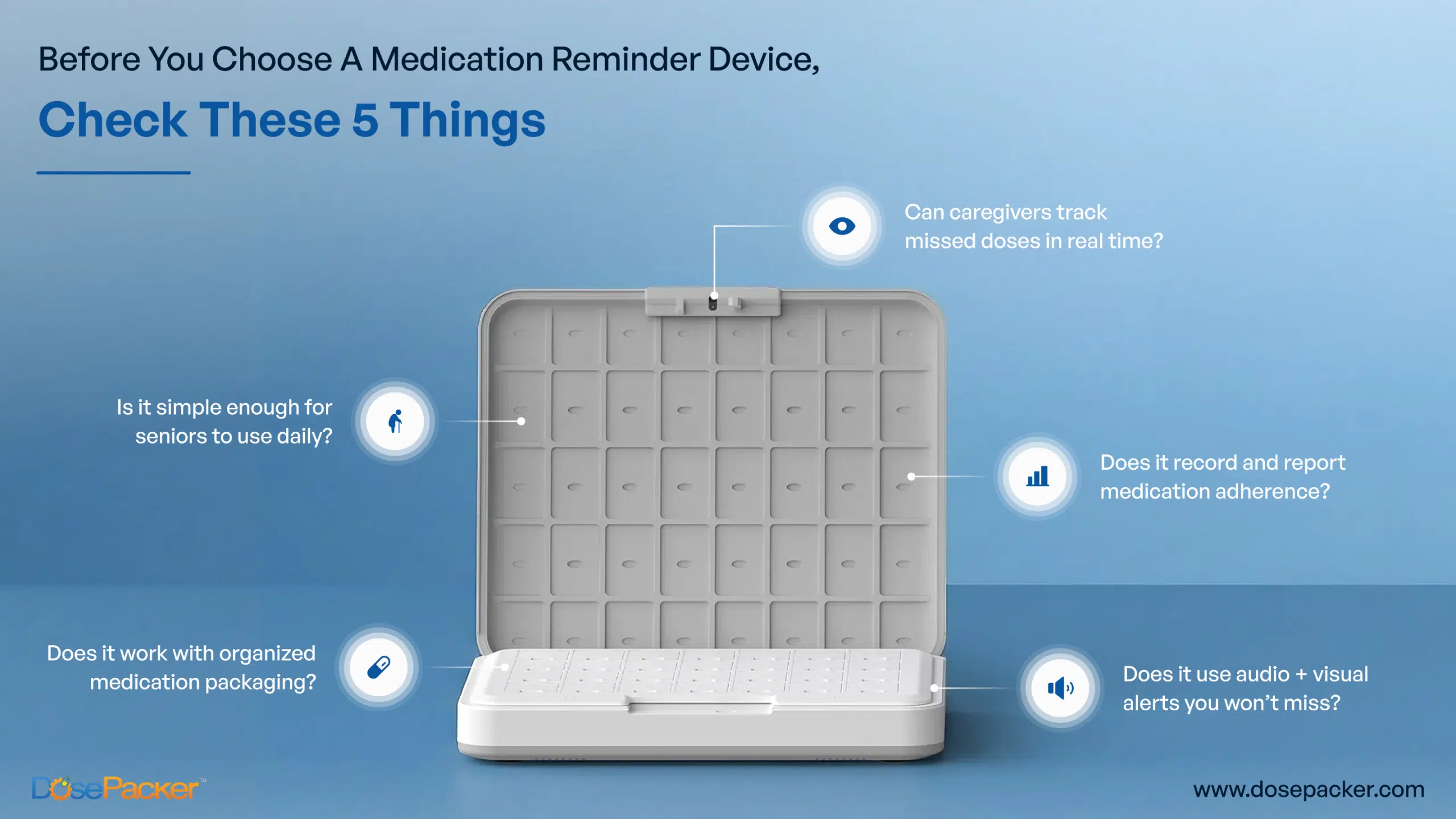
A phone beep is easy to miss. A medication reminder device for seniors should offer multiple alert formats: audio alarms, visual lights, and push notifications to account for hearing impairment, visual changes, and varying attention levels throughout the day. The best systems escalate alerts if a dose is not acknowledged, rather than simply falling silent.
Complexity is the enemy of adherence. If a device requires a senior to navigate multiple screens, remember a PIN, or manage a complicated interface, it will be abandoned. Look for large buttons, an intuitive design, minimal steps to confirm a dose, and interfaces specifically tested with older adults. Simplicity is not a limitation; it is a design feature.
The best medication reminder devices for seniors send real-time alerts to caregivers, family members, or care community staff when a dose is missed or skipped. This closed-loop communication transforms what was previously a guessing game into a transparent, documented process. Care teams can intervene early rather than waiting for a health crisis to signal non-adherence.
A device that only reminds but does not record is only halfway useful. Look for systems that log when doses are taken, skipped, or confirmed and that make this data accessible to healthcare providers. When a doctor can see a 30-day adherence history at a glance, they can make much more informed decisions about a patient’s care plan.
Medication reminder devices are most effective when they align with how medications are physically organized. Devices that connect with compliance packaging, pre-sorted dose cups, clearly labeled by time and date, eliminate the “did I take the right pill?” question entirely. The reminder and the medication become one seamless system.
For care communities, a solution that works for one resident but cannot scale to 30, 50, or 100 is not a solution. Look for medication reminder devices that integrate with facility-wide care management software, support multiple patient profiles, and generate documentation that satisfies regulatory and compliance requirements.
Particularly for seniors living at home or in assisted living settings, the medication reminder experience should feel supportive rather than surveillance-heavy. Devices should be designed to empower rather than monitor, giving seniors a sense of control and agency over their own health routines.
DosePacker does not approach medication reminders as a single-point solution. Instead, it’s an interconnected ecosystem where medication packaging, smart reminder devices, mobile apps, and care management software work together to support adherence at every step, from the pharmacy counter to the patient’s bedside.
This connected approach matters because the root causes of missed doses are not uniform. Some seniors forget because of memory changes. Others miss doses because of confusing packaging. Some simply do not receive the support and follow-up they need from their care team. DosePacker’s ecosystem addresses each of these failure points with a targeted, integrated solution.
Here’s how the three key reminder-focused components work together.
DoseMinder is one of the most thoughtfully designed medication reminder devices specifically for seniors living at home or in care settings who need both prompting and verification.
It’s a smart medication storage device that syncs with the MyDoses app. When it is time for a dose, DoseMinder delivers clear, attention-capturing audio-visual alerts that are impossible to confuse with background noise. The alerts are designed with older adults in mind: loud enough to be heard, visible enough to be noticed, and simple enough to act on without confusion.
What sets DoseMinder apart from most medication reminder devices is its video confirmation capability. When a senior opens the device and takes their dose, DoseMinder captures a video confirmation of the medication intake. This is not passive tracking: it is active, documented evidence that the dose was taken correctly and on time.
That verification matters in more ways than one. For family members who live far from an aging parent, knowing that a dose was confirmed with video gives genuine peace of mind, not just an app notification that could mean anything. For care providers reviewing a patient’s adherence history, the video record provides a level of detail and confidence that no simple timestamp can match.
DoseMinder bridges independent living and connected care, keeping seniors autonomous while ensuring their care network has the real-time visibility it needs to intervene early if anything changes.
The MyDoses app serves as a personal medication-management companion and is one of the most important touchpoints in DosePacker’s medication-reminder ecosystem.
The app connects directly with DosePack compliance packaging. Each dose cup includes a QR code that care teams or patients can scan to confirm the correct medication at the right time. This QR-based verification process does two things simultaneously: it confirms that the correct dose is being administered, and it automates eMAR (electronic medication administration record) documentation in real time. What once required manual data entry becomes an effortless, automatic part of the routine.
For seniors managing medications at home, MyDoses delivers timely dose reminders that can be acknowledged with minimal steps. The app’s interface is designed for ease of use, so seniors do not need to be particularly tech-savvy to benefit from it. If a reminder is snoozed, the app follows up. If a dose is missed, care teams and family members are notified promptly.
Adherence tracking within the app provides a running history of which doses were taken, when, and by whom, data that becomes invaluable during care visits or medication reviews. Healthcare providers can see patterns rather than anecdotes, enabling much more precise and proactive care planning.
The MyDoses app also supports medication refill requests, helping close another common gap in senior adherence: running out of medication simply because the refill process felt too complicated.
For care communities managing medication schedules across dozens or hundreds of residents, individual reminder devices are not enough. What is needed is a centralized platform that connects every patient profile, every medication schedule, and every caregiver action into a single, coherent workflow.
That is what CareCommunityOS provides. As the central software platform in DosePacker’s ecosystem, it manages resident profiles, medication schedules, documentation, and care workflows – all in one place!
From a medication reminder standpoint, CareCommunityOS sends timely alerts to caregivers ahead of med-pass, helping care staff prepare rather than scrambling at dose time. The platform gives care teams a clear, real-time picture of which residents have received their medications and which have not, enabling early intervention before a missed dose becomes a health event.
CareCommunityOS also generates the kind of documentation that care communities need for regulatory compliance, without adding paperwork burden to already stretched staff. Because documentation is a natural byproduct of the care workflow rather than a separate manual task, accuracy improves and administrative time decreases.
For care communities, this combination of caregiver support, resident-level tracking, and automated documentation makes CareCommunityOS far more than a reminder system; it is a foundation for safer, more consistent medication management across the entire facility.
Not every senior has the same needs, and not every care setting has the same infrastructure. Here is a brief guide to matching the right solution to the right context.
1. For seniors living independently at home: The combination of DoseMinder and the MyDoses app offers the most meaningful support. DoseMinder provides reliable alerts and video confirmation, while MyDoses gives family members and care providers the visibility they need without requiring the senior to report to anyone manually.
2. For assisted living and senior living communities: MyDoses combined with CareCommunityOS creates a comprehensive medication reminder and documentation workflow that scales across residents while keeping caregiver workflows organized and efficient.
3. For home health and hospice care environments: The MyDoses app, paired with DosePack compliance packaging, enables home health aides to quickly and accurately verify and document medications during visits, while ensuring patients are supported between visits with timely reminders.
4. For PACE programs and behavioral health settings: CareCommunityOS provides the clinical oversight and multi-resident management capabilities that complex, high-acuity environments require, with medication reminders integrated into a broader care coordination platform.
Whatever the setting, the most effective approach is one in which medication reminder devices do not stand alone; they are integrated with packaging, documentation, and care team communication to create accountability at every point in the medication journey.
Medication reminders for seniors are not about distrust or surveillance. They are about giving older adults and their care teams the support they need to do something genuinely difficult: manage complex health regimens consistently, every day, across changing health conditions and life circumstances.
The best medication reminder device for seniors is not necessarily the most expensive or the most feature-rich. It is the one that fits the senior’s actual life, works reliably within the care setting’s existing workflows, and connects seamlessly with the rest of the medication management system.
DosePacker has built its medication reminder solutions with this philosophy at the center, because a reminder that does not reach the right person at the right time, in the right way, is not really a reminder at all.
