
Explore 10 advanced medication carts for 2027, compare their features, and discover what to consider when choosing a solution for your facility.
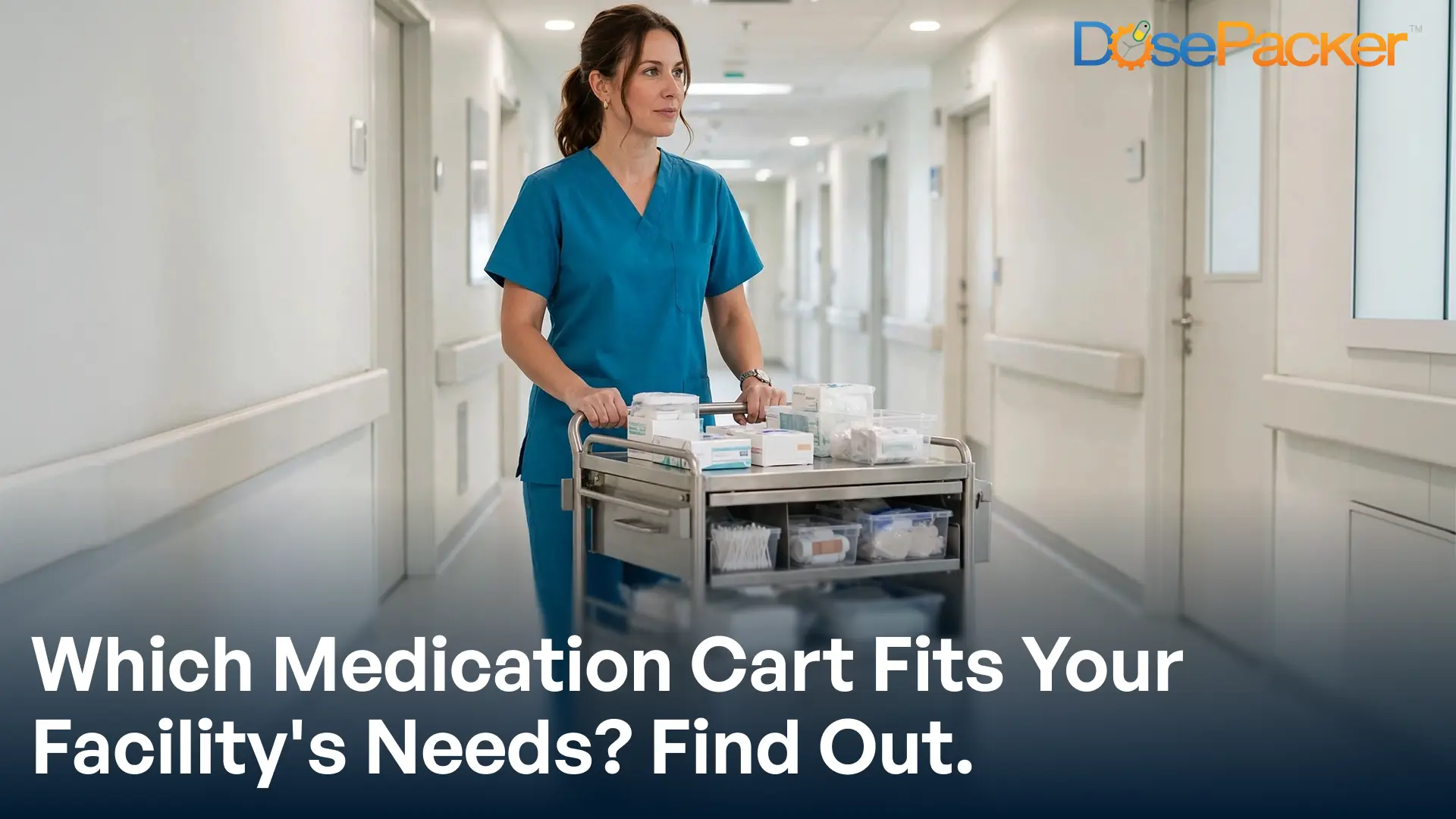
A medication round can involve dozens of individual tasks. Caregivers and nurses must locate the right medication, document administration, and move between patients or residents while keeping the process organized. The medication cart supporting these activities can make a considerable difference to the daily workflow.
The importance of getting medication administration right is well established. According to a review, medication errors in acute hospitals occur at an estimated rate of approximately 6.5 per 100 admissions. These errors can involve the wrong medication, dosage, route, or patient. Although a medication cart alone cannot prevent these incidents, its storage design, security features, and integration with medication administration processes can support safer workflows.
The challenge is identifying which features make a real difference in daily operations.
In this guide, we explore 10 advanced medication carts for hospitals and long-term care facilities, examine their capabilities, and discuss what healthcare teams should consider before investing in one.
Not every healthcare facility needs the same type of medication cart. A hospital may prioritize patient-specific electronic locking and bedside barcode verification, while a long-term care facility may prioritize easy mobility, high-capacity storage, and organized medication passes.
The following options represent different approaches to medication storage, transportation, security, and digital integration. They are presented as products worth evaluating, not as an independently verified ranking of performance or customer ratings.
Best suited for: Long-term care facilities, assisted living communities, and care teams managing regular medication rounds.
When caregivers move through a facility throughout the day, the medication cart becomes part of their everyday working environment. A heavy cart, difficult-to-access drawers, or poorly organized medication storage can make routine tasks more demanding.
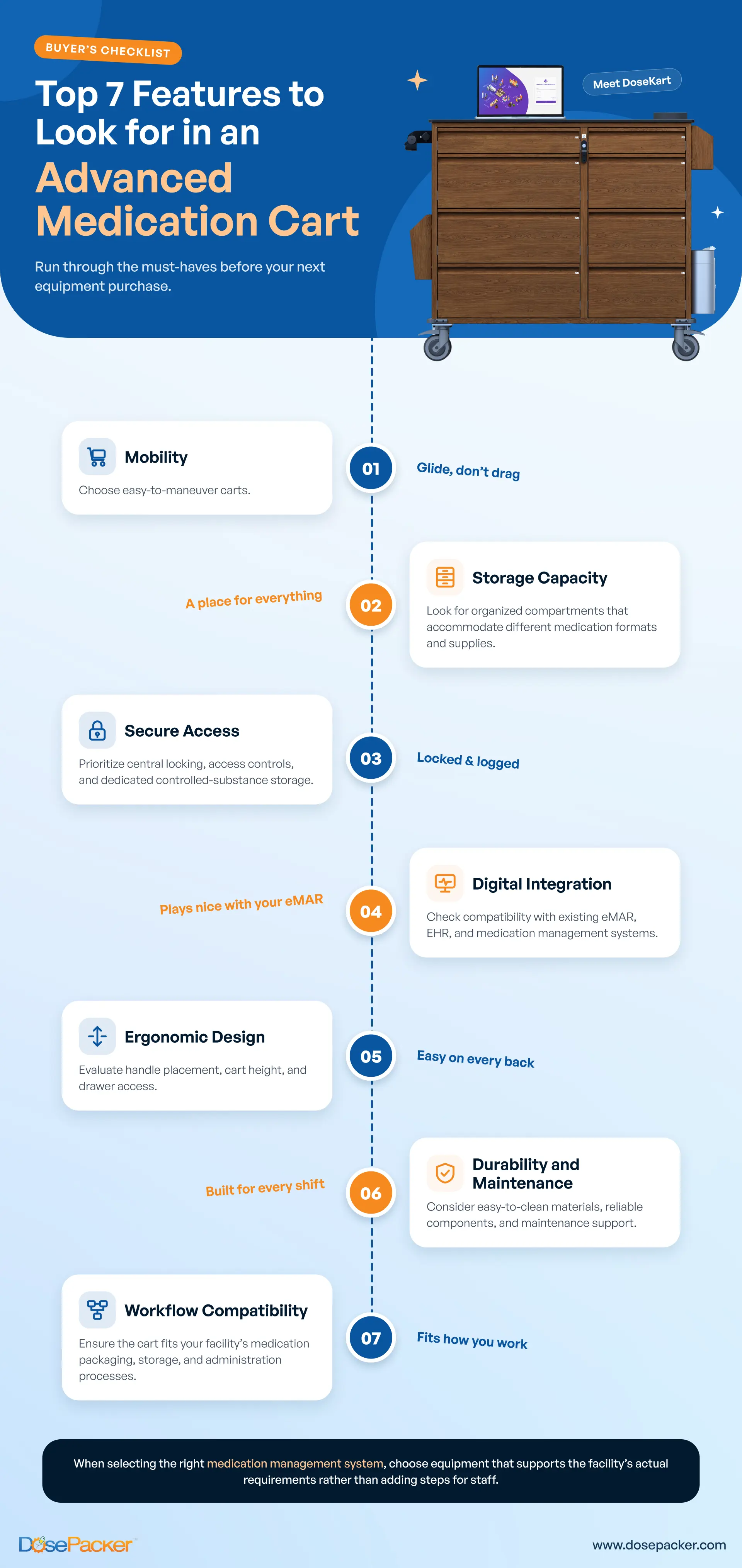
DoseKart medication cart takes a different approach by combining customizable storage and digital integration in one medication cart.
Unlike conventional carts that rely entirely on manual pushing, DoseKart moves easily with ergonomic handles.
Its storage configuration is designed around different medication requirements:
The central locking mechanism secures the drawers together, helping caregivers manage medication access through a more organized system.
Another important advantage is its integration with DosePacker's digital ecosystem. DoseKart connects with CareCommunityOS and the MyDoses app, supporting medication tracking and connected care workflows.
Additional features include a multipurpose top tray for frequently used supplies and an accessible charging point.
Why Consider DoseKart?
Its value lies in combining mobility, storage, and digital coordination. Rather than treating the medication cart as a transport unit alone, DoseKart is designed around the actual requirements of medication rounds.
For teams exploring alternatives to conventional equipment, understanding DoseKart vs. traditional med carts provides a useful starting point.
Best suited for: Hospitals, assisted living facilities, nursing homes, and continuing care communities.
Capsa Healthcare's Vintage Encore Tech-Ready cart meets these needs with a furniture-style design and integrated computing capabilities.
The cart combines medication storage with a workstation that can accommodate laptops, tablets, and all-in-one computers. Its adjustable computer arm and slide-out keyboard-and-mouse drawer let healthcare professionals access electronic records while moving between patients.
The design also considers the medication storage process. Configurable drawers can accommodate different medication delivery systems.
Soft-close drawers, a slide-out work surface, and optional locking configurations add to its functionality. Its wood-finish exterior also makes it suitable for senior care environments where facilities want equipment that complements the surrounding interior.
Best suited for: Hospitals and healthcare facilities that prioritize secure bedside medication delivery.
TouchPoint Medical's AccessPoint Secure medication delivery workstation addresses this medication security challenge with individually locking, patient-specific drawers.
The workstation lets healthcare professionals access patient information at the bedside and use configurable, software-based locking systems. Its design supports barcode scanning during medication administration, helping facilities maintain their barcode medication administration (BCMA) workflows.
The cart also offers flexibility in its computer configuration, battery options, and peripheral accessories.
Its ergonomic design allows healthcare professionals to access the workstation comfortably while moving between patient rooms.
Best suited for: Hospitals looking to connect pharmacy workflows with bedside medication administration.
Medication delivery involves several stages, from pharmacy preparation to administration at the patient's bedside.
TouchPoint Medical's AccessPoint MD connects these stages through patient-specific medication drawers and integrated software.
The system supports barcode-based patient identification and direct eMAR API access. Its ADT interface also helps eliminate manual drawer labeling by using patient information from connected hospital systems.
Time-based access controls help restrict medication availability according to the intended administration schedule.
The workstation supports real-time bedside medication administration, with a software architecture that can scale with changing facility requirements.
Best suited for: Hospitals seeking greater accountability and organization during medication delivery.
Capsa Healthcare's MedLink Medication Management Cart uses patient-specific, electronically labeled drawers to quickly identify the correct medication.
Staff can load medications into the drawers at the pharmacy, automated dispensing cabinet, or nursing station. Once prepared, the system electronically assigns the drawers to individual patients.
The system uses patient wristband scanning to help healthcare professionals access the appropriate medication drawer.
This creates a more connected medication delivery process, linking medication preparation and patient identification to point-of-care access.
Best suited for: Hospitals and clinics that need configurable medication storage and workstation options.
Healthcare facilities often have different requirements depending on their departments, medication distribution methods, and documentation processes.
Scott-Clark Medical addresses this through customizable medication carts designed around specific clinical workflows.
Its patented medication cart features a lightweight construction, a large desktop, and full-size medical drawers. The design accommodates both left-handed and right-handed users and includes height adjustability.
Electronic drawer locking is another important feature, supporting controlled access to stored medications.
Facilities can also configure carts with computer equipment, barcode scanners, and other accessories to meet their needs.
Scott-Clark uses aluminum and stainless steel in its cart construction, emphasizing durability and ease of maintenance.
Best suited for: Long-term care facilities and pharmacies managing large medication volumes.
The Phoenix LTC Series 99 MD/UDB supports high-capacity storage configurations.
The MD version accommodates 24 divided sections, while the UDB version supports up to 99 unit-dose boxes.
Its adjustable divider system allows facilities to organize different medication packaging formats. Additional features include a pull-out side shelf, precision-bearing casters, full-height drawer pans, and dedicated narcotics locking.
Phoenix LTC also offers an exchangeable core locking system and a five-year warranty on this cart configuration.
Best suited for: Hospitals, pharmacies, and long-term care facilities with specific medication packaging requirements.
Harloff offers medication carts designed for different packaging requirements, including Dispill and Medicine-On-Time systems.
Its product range includes different drawer sizes, medication storage configurations, and locking options. Certain models also feature separate locking narcotics storage and electronic keypad access.
The company offers carts with varying capacities to accommodate different medication volumes. For example, its specialized packaging range includes configurations for Dispill and Medicine-On-Time cards.
Best suited for: Hospital wards and clinical environments that need organized medication access.
Advantech's AMiS-50M medication cart is designed for patient medication administration in hospital wards. Its individual bin locking mechanism helps healthcare professionals maintain greater control over medication access.
The AMiS range also reflects Advantech's focus on customizable medical cart solutions for hospitals and clinics.
The wider platform includes options for integrating healthcare technology and adapting mobile workstations to different clinical requirements.
Best suited for: Healthcare facilities managing medication storage for multiple patients.
Waterloo Healthcare's Full-Sized 50 Bin Max accommodates up to 50 individual patient bins.
The configuration combines multiple cassette sections with additional drawers for medication and supplies. It also includes a separately locking narcotics drawer, a central key-locking system, and a pull-out shelf.
The cart is constructed from heavy-duty steel and features ergonomic push handles, ball-bearing drawer slides, and a caster configuration with braking and directional control.
Its design combines patient-specific organization with general medication storage.
The right choice depends on how the facility manages medication administration, its existing technology, and the level of staff support required.
The right cart depends on the facility's medication distribution model, patient population, packaging arrangements, and daily staffing requirements.
Rather than beginning with a manufacturer's feature list, start by understanding the workflow the cart needs to support.
Large hospitals may need medication carts that accommodate frequent movement between patient rooms, multiple medication formats, and digital documentation.
Consider individually locking drawers, barcode scanning, electronic access, and computer integration.
The cart should also fit the hospital's physical layout, including corridor width, elevator access, and available storage areas.
Senior living and extended-care environments often manage medication across multiple residents with different administration schedules and packaging requirements.
Here, storage capacity, patient-specific organization, accessible drawers, and compatibility with multi-dose compliance packaging become important.
Facilities may also benefit from carts that integrate with medication storage solutions and tracking processes, rather than operating as isolated equipment.
Organizations receiving unit-dose or strip-packaged medications should prioritize carts designed around those formats.
Check whether the cart accommodates the pharmacy's medication packaging system and whether the drawer configuration supports the facility's medication distribution cycle.
This can reduce the need for staff to rearrange medication packaging to fit the cart.
If a facility is moving toward electronic medication documentation or barcode verification, the cart should support that transition.
Evaluate connectivity, software compatibility, device mounting, charging, and access control before committing to a technology-enabled model.
The goal is to ensure the cart fits the wider medication workflow and doesn't introduce another disconnected system.
The right medication cart should make everyday medication administration easier to organize, manage, and document.
Some facilities may benefit from patient-specific electronic drawers and barcode identification. Others may need higher storage capacity or compatibility with existing compliance packaging.
The 10 options in this guide demonstrate how medication cart designs have evolved to address these different requirements.
For care facilities looking beyond conventional medication storage, DoseKart brings everything together in one solution.
The important consideration is how well the cart fits the people using it and the medication workflows it needs to support.
Looking for a Smarter Way to Manage Medication Rounds?
Disclaimer: This article is for informational purposes only and does not constitute medical advice or an endorsement of clinical effectiveness. Product features, specifications, configurations, and availability may change. Verify current details with the respective manufacturers before purchasing. Select and use medication carts in accordance with facility policies, medication administration protocols, and applicable regulatory requirements.
