
Medication passes demand accuracy, organization, and constant movement. Learn how DoseKart helps nursing teams manage medications more efficiently with a medication cart designed around the realities of care community workflows.

A medication pass is a sequence of small, time-sensitive tasks. A nurse or caregiver moves between residents, retrieves the correct medication, verifies the dose, administers it, documents the administration, and continues to the next resident. When the equipment used during this process is difficult to maneuver, access, or organize, those small inefficiencies can add up across an entire medication pass.
Medication errors remain a significant patient-safety concern, with at least 1.5 million people affected each year in the United States. These errors can occur throughout the medication-use process, including dispensing, distribution, administration, and monitoring.
For nursing teams, the medication cart is part of the administration workflow. Its mobility, storage configuration, accessibility, and security can influence how efficiently staff prepare for and complete medication passes.
A well-designed medication cart therefore needs to do more than store medications. DoseKart supports the movement, organization, security, and accessibility requirements of medication management in care communities.
Make Medication Passes More Efficient
A medication cart is part of the nursing workflow, and its design can affect how efficiently staff move through a medication pass. Mobility, storage configuration, and access to frequently used items all affect the physical effort and time required during a round.
Medication rounds can involve considerable walking, turning, repositioning, and repeated cart movement. A difficult-to-maneuver cart can increase the physical effort required during a round. Cart dimensions, wheel configuration, handle placement, braking, and the facility's physical layout can all affect how easily staff can move and position the cart.
Also consider the physical environment when selecting a cart. Corridor widths, doorways, elevators, floor surfaces, and distances between medication preparation areas and resident rooms can influence which cart configuration is practical for a facility.
Storage design affects how staff organize and retrieve medications during a medication round. Drawer configuration, compartment size, labeling, and placement of frequently accessed items can help create a consistent arrangement for medications and supplies.
This becomes especially important when a med cart must accommodate compliance packs, other medications, administration supplies, and controlled medications. Effective medication storage in care facilities should also account for security requirements, medication volume, and how staff access medications during rounds.
Medication security must remain consistent throughout the round, including when staff move between resident areas or temporarily step away from the cart. Locking mechanisms and dedicated storage for controlled medications can help maintain appropriate access controls.
Security should support workflow rather than create unnecessary interruptions. Facilities should consider how medications are secured between uses and whether the cart's locking and storage configuration aligns with existing medication management procedures.
An inefficient medication cart can affect more than individual tasks. When equipment does not align with established workflows, staff may need to make adjustments throughout the day. These adjustments can affect consistency, workload, and how easily teams maintain standardized medication administration practices.
Medication rounds require staff to move through a defined sequence of activities. When equipment doesn't support that sequence, staff may need to pause one task to address another. Repeated task switching can make the workflow less predictable and increase the cognitive effort required to complete routine responsibilities.
When a cart does not adequately support established procedures, staff may develop informal workarounds to keep rounds moving. These may include rearranging items, adding preparation steps, or modifying established routines. Over time, these workarounds can make processes less consistent between staff members or shifts.
Consistent medication administration depends on repeatable processes. Equipment that fits those processes makes it easier for teams to follow the same approach across rounds and shifts. Conversely, equipment that requires frequent adjustments can introduce variation into otherwise standardized workflows.
For administrators, these considerations make the med cart part of a broader operational assessment. This assessment can also help facilities determine whether their current medication storage solutions provide the organization, accessibility, and security required for daily medication workflows.
Start by matching the medication cart to the workflow it needs to support. If your team is researching how to choose the best medication cart, consider these six operational factors:
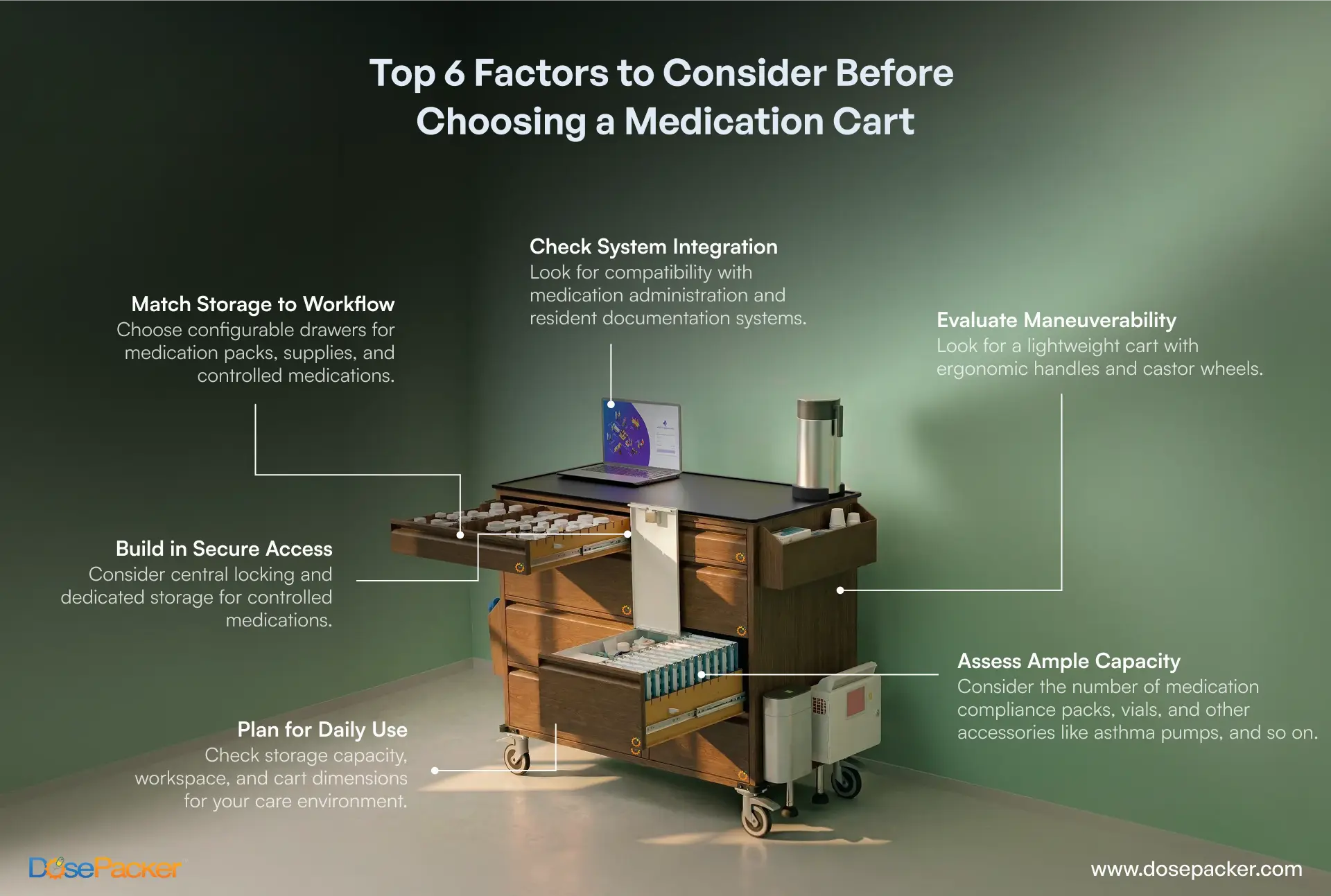
A medication cart needs to work with how nursing staff actually move during a medication round. Staff need to move between resident areas, access medications and supplies without unnecessary searching, keep medications secure, and continue the round without repeatedly stopping to manage the cart itself.
DoseKart brings these practical requirements together through its mobility, storage, security, and workflow features.
Moving a medication cart repeatedly throughout a shift can add physical effort to an already demanding routine. DoseKart is significantly lighter than other medication carts, making it easier to navigate the care community.
Storage becomes more useful when staff can quickly recognize where different items belong. DoseKart offers configurable drawer options for DosePacks, other medications and supplies, and narcotics.
This gives facilities flexibility to organize the cart around their existing medication workflow rather than adapting every round to a fixed storage layout.
DosePacks can remain on the cart during the medication round, while a multi-purpose top tray keeps frequently needed supplies within reach. A built-in charging port also keeps the unit powered between rounds.
Medication security must remain consistent even when staff move between resident areas or briefly step away from the cart.
DoseKart uses central locking to secure drawers with one action, plus a dedicated narcotics storage configuration for controlled medications. This keeps security part of the routine rather than adding another separate task for staff to manage.
The medication cart is only one part of medication management. The information surrounding each medication also needs to remain organized as it moves through the administration process.
DoseKart integrates with CareCommunityOS for EHR and resident health records and MyDoses for medication tracking and reminders. This connects the physical movement of medications with the digital systems that support the broader medication workflow.
The result is a more connected process: the cart supports the medication round, while the surrounding DosePacker ecosystem supports organization and tracking before, during, and after administration.
Together, these capabilities show how a medication cart's design can shape the practical experience of completing a medication round. The value lies less in adding features for their own sake and more in reducing the small interruptions that make routine medication administration harder to manage.
For facilities comparing DoseKart vs. traditional med carts, the key consideration is how each option fits the actual medication workflow, including movement, storage, security, and integration with existing systems.
A medication cart is part of the environment where nursing teams administer medications. When the workflow is organized around how staff actually move, access medications, and care for residents, routine rounds can become easier to manage and more consistent.
DoseKart is designed to fit that workflow, giving care communities an option that accounts for the practical demands staff face during a medication round.
See How DoseKart Fits Your Care Community
