
White bagging practices affect how 340B-participating providers access drug discounts. Understanding the options helps healthcare organizations make informed decisions about pharmacy operations.

A clinic coordinator receives a call, the specialty medication for today’s patient hasn’t arrived from the insurance company’s contracted specialty pharmacy yet. The appointment gets rescheduled, and the care team spends the next hour coordinating with multiple parties to track down the shipment. Meanwhile, the organization realizes it purchased this drug at commercial rates rather than accessing its 340B discount.
This scenario plays out regularly across FQHCs, rural health clinics, and safety-net hospitals as white bagging practices intersect with 340B drug pricing programs. For organizations serving vulnerable populations, understanding this dynamic and exploring solutions like specialized CE-owned pharmacy implementation services has become an important part of operational planning.
White bagging occurs when payers require specialty medications to be shipped directly from their contracted pharmacy to the provider location. Rather than the provider’s pharmacy dispensing the drug, it arrives from an external source, typically in a white bag or box, which gives the practice its name.
Payers implement this approach as part of their specialty drug management strategies, seeking to optimize medication costs and oversight. The practice primarily affects high-cost specialty medications, including cancer infusions, biologics, and other complex therapies.
According to Drug Channels Institute’s 2024 analysis, white bagging has grown considerably over recent years. What began as an occasional requirement has evolved into standard practice across many insurance plans. For patients, this means their medication arrives at the clinic rather than being prepared on-site, though the financial implications for the healthcare organization often remain invisible.
Brown bagging is a related practice in which patients pick up medications from a retail pharmacy and transport them to their appointment, adding coordination steps for both patients and providers.
The 340B program provides covered entities, FQHCs, critical access hospitals, and other safety-net providers with access to outpatient drugs at significantly discounted prices. These discounts typically range from 25% to 50% off wholesale costs, generating savings that organizations reinvest in patient assistance programs, expanded services, and care for uninsured individuals.
When payers designate which pharmacy must dispense a medication, this affects the provider’s ability to access 340B pricing. External pharmacies selected by payers generally don’t qualify as 340B contract pharmacies for the covered entity, so the medication is purchased at commercial rates rather than discounted 340B prices.
The financial implications can be substantial. Healthcare organizations may experience a significant revenue impact from white-bagging arrangements. For a community health center or rural hospital, this translates to fewer resources available for medication assistance programs, sliding-scale services, or care coordination for complex patients.
These savings support mission-critical programs. When 340B discounts aren’t accessible, organizations face difficult decisions about which services to maintain, reduce, or restructure to work within available funding.
The regulatory environment adds complexity. Federal law doesn’t explicitly address white bagging practices, creating variation across states. As of July 2025, 12 states have banned mandatory white and brown bagging, while others leave providers navigating payer contracts with limited guidance.
White bagging introduces several operational factors that healthcare organizations need to manage effectively.
Many specialty drugs need precise temperature control throughout storage and transport. When medications pass through multiple handlers, from external pharmacies to shipping services to clinics, maintaining consistent conditions requires robust systems and documentation.
Organizations report challenges with timing mismatches, where medications arrive before or after scheduled appointments. Staff time shifts from direct patient care to logistics coordination with external pharmacies and shipping companies. KFF Health News documented patient experiences with these arrangements, noting concerns about delays and added complexity in care delivery.
Liability and accountability questions arise when multiple parties handle medications before administration. Establishing clear protocols for receiving, inspecting, storing, and documenting externally sourced medications is essential for quality assurance and risk management.
Storage capacity may need adjustment. Clinics receiving medications several days before appointments require adequate refrigeration and secure storage space that meets pharmacy standards.
ASH Clinical News provides a detailed analysis of these operational considerations, noting that successful white bagging implementation requires thoughtful planning and resource allocation to maintain medication integrity and patient safety standards.
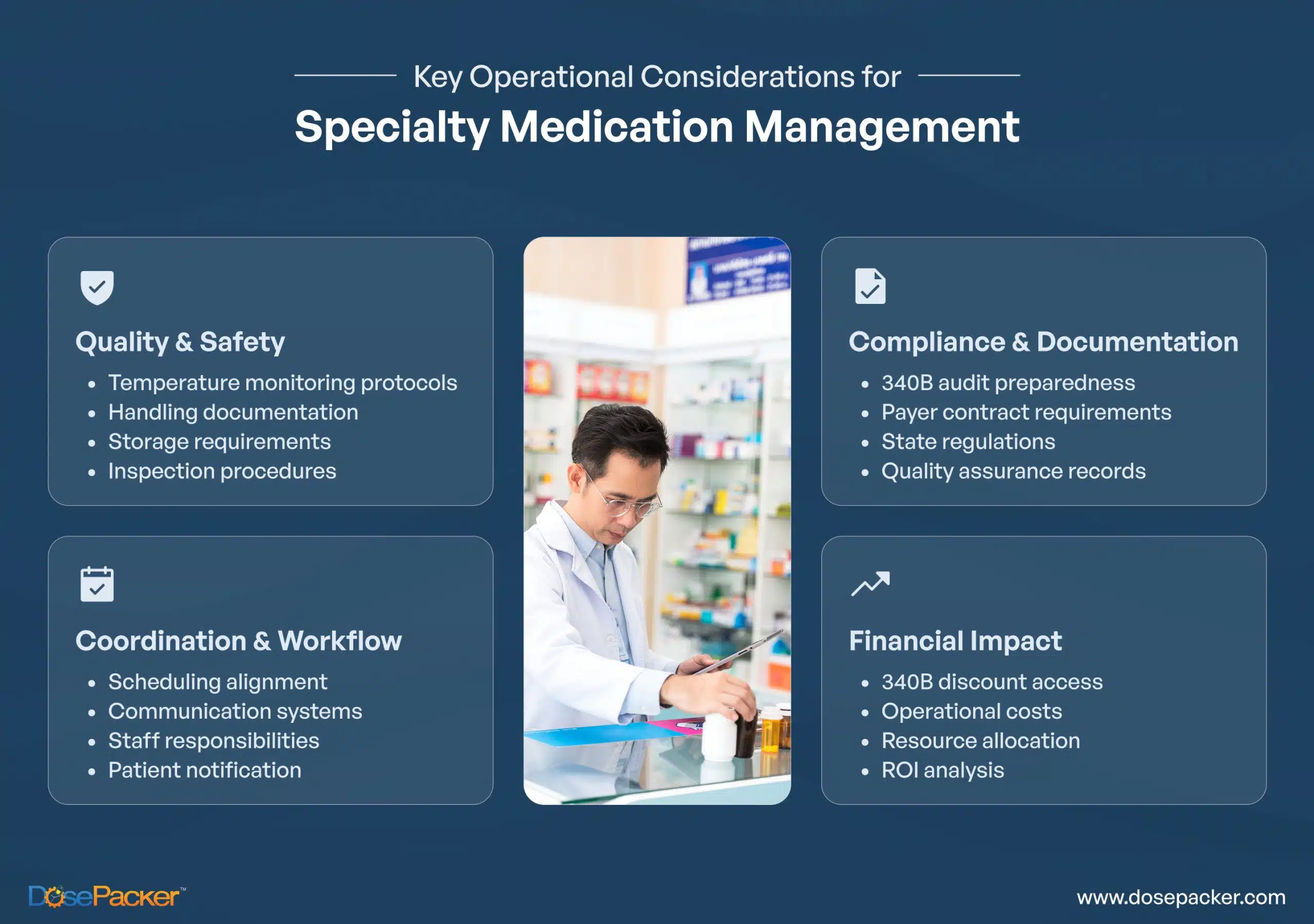
Clear bagging offers healthcare organizations a way to address specialty medication management while preserving 340B program eligibility. In this model, a covered entity-owned pharmacy dispenses the medication and coordinates delivery to the clinic for administration.
The operational difference centers on pharmacy ownership. When the covered entity controls the dispensing pharmacy, it maintains eligibility for 340B discounts while still providing the medication sourcing transparency that payers seek.
Organizations implementing clear bagging report several advantages:
Implementing clear bagging requires appropriate infrastructure and expertise. DosePacker’s DosePacker’s specialized pharmacy services can provide the systems, packaging, temperature monitoring, tracking capabilities, and compliance support that organizations need for CE-owned pharmacy implementation. These partnerships allow health centers and hospitals to maintain 340B eligibility without building entirely new pharmacy operations.
This approach aligns well with the resource optimization that safety-net providers require. Every dollar of 340B savings preserved supports the organization’s ability to serve patients regardless of insurance status or ability to pay.
The regulatory landscape in some states increasingly supports clear bagging as an option, with legislation clarifying provider rights around pharmacy choice and medication sourcing. Organizations benefit from staying informed about both state-level developments and evolving payer contracting practices.
Organizations currently navigating white bagging requirements or anticipating future payer mandates can take several practical steps.
Identify which medications and payer contracts currently involve white bagging. Quantify the 340B revenue implications by analyzing specialty drug spend and calculating the discount differential between 340B and commercial pricing.
Review Existing Payer Contracts
Review existing payer contracts for language around pharmacy choice and specialty medication sourcing. Some agreements include provisions for discussion or exception processes, particularly for 340B-participating providers. Contract renewal periods present opportunities to address these terms proactively.
Track coordination time, workflow disruptions, storage challenges, and any medication handling concerns. This data informs both internal decision-making and external discussions with payers or policymakers.
Some organizations have the volume and infrastructure to establish covered entity-owned pharmacies. Others benefit from partnering with specialized pharmacy services that understand 340B compliance and can provide turnkey solutions. Financial modeling should compare implementation costs against projected 340B savings retention over multiple years.
State pharmacy associations, hospital associations, and organizations like 340B Health track legislation and regulatory developments. Participating in these efforts helps shape policy while keeping your organization informed about changes that may affect operations.
When discussing arrangements with payers, approach conversations with data. Present comprehensive information about medication costs, coordination expenses, quality protocols, and patient access implications. Many payers are willing to explore alternative arrangements when providers offer well-documented proposals.
Resources like AMCP’s overview of bagging practices can help educate leadership teams, board members, and staff about the various models and their implications for your organization.
Building relationships with peer organizations facing similar challenges provides a valuable perspective. FQHCs, rural health clinics, and safety-net hospitals often benefit from sharing approaches and lessons learned around pharmacy operations and 340B program optimization.
White bagging represents one of several evolving practices in specialty pharmacy management. For 340B-participating organizations, understanding how these practices affect program savings and operational efficiency supports informed strategic planning.
The intersection of payer requirements and 340B program rules creates both challenges and opportunities. Organizations that proactively assess their situations, explore available options like clear bagging, and engage thoughtfully with payers and policymakers position themselves to maintain the resources that support their missions.
Consider conducting a white bagging impact assessment for your organization. How do current arrangements affect your 340B revenue? What would retained savings enable in terms of patient programs and community services? Which implementation models, pharmacy ownership, specialized partnerships, or hybrid approaches, align with your operational capacity and strategic goals?
Exploring DosePacker’s CE-Owned pharmacy implementation solutions designed for safety-net providers can clarify options and provide support tailored to your organization’s needs.
The healthcare landscape continues evolving, but the core mission remains constant: providing high-quality care to everyone in your community. Thoughtful approaches to pharmacy operations and 340B program management support that mission by preserving resources and optimizing how your organization serves patients.
