
Discover how formulary management supports safer medication use, controls costs, streamlines pharmacy operations, and improves care across long-term care settings.

Medication decisions affect far more than drug costs. Every medication added to a pharmacy's approved drug list influences clinical outcomes, inventory management, reimbursement, regulatory compliance, and the efficiency of daily dispensing workflows. The stakes are significant: according to the World Health Organization (WHO), unsafe medication practices and medication errors cost an estimated US$42 billion globally every year, underscoring the importance of medication safety across healthcare systems.
As organizations invest in more structured and data-driven approaches to medication use, the global drug formulary management market is projected to grow at a 5.9% CAGR between 2024 and 2031, reflecting rising demand for evidence-based pharmacy operations.
Against this backdrop, formulary management has become a core responsibility for healthcare organizations and long-term care pharmacies. By guiding medication selection through clinical evidence, safety, and cost considerations, it supports more consistent and patient-centered care.
It’s also why DosePacker’s medication management solutions are designed to integrate directly into long-term care pharmacy workflows as systems that connect formulary decisions with dispensing and administration.
See how DosePacker supports better formulary-driven workflows.
Formulary management is the ongoing process of evaluating, selecting, maintaining, and reviewing the medications approved for use within a pharmacy, health system, or healthcare organization. It balances clinical effectiveness, patient safety, operational needs, and cost to ensure patients receive appropriate medications while supporting efficient pharmacy operations.
At its core, pharmacy formulary management asks one repeated question: Is this the safest, most effective, and most cost-appropriate medication available for this patient population today? Answering that well and keeping the answer current is the job.
A poorly maintained formulary creates friction throughout the medication management process. Physicians may prescribe medications requiring prior authorization or those that aren’t covered, pharmacists spend valuable time processing substitutions and clarifications, and residents experience unnecessary delays in receiving therapy.
A well-managed formulary creates the opposite outcome. It helps organizations:
In long-term care specifically, where medication regimens are often complex and residents transition between care settings frequently, a reliable formulary reduces the likelihood of delays, medication errors, and gaps in therapy.
Formularies can take different forms depending on a healthcare organization’s goals, payer requirements, and the level of clinical control needed within the system. While the structure may vary, every formulary is designed to guide medication selection to balance safety, effectiveness, and cost.
In some settings, formularies are designed to support broader prescribing flexibility, allowing clinicians access to a wider range of therapeutic options. In others, they are more structured, focusing on standardization and tighter control over medication choices to improve consistency and manage costs.
Most healthcare organizations operate somewhere along this spectrum rather than at either extreme. The approach they choose often reflects factors such as patient complexity, regulatory requirements, contracting arrangements, and overall pharmacy strategy.
What remains consistent across all models is the purpose: to ensure that medication use is evidence-based, financially sustainable, and aligned with safe, coordinated patient care.
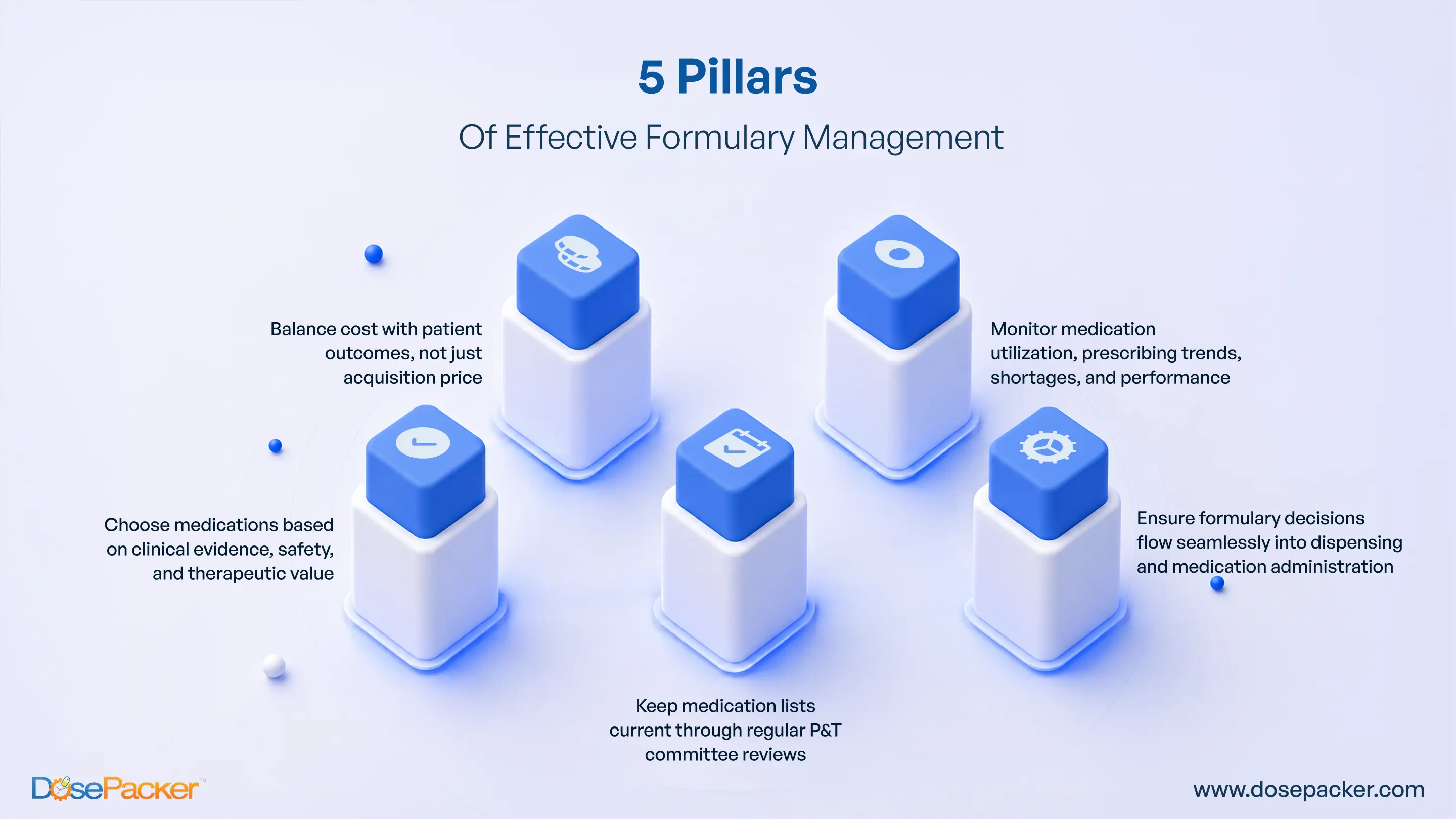
Although every organization follows its own workflow, the formulary management process generally includes several recurring stages.
New medications are reviewed for clinical evidence, safety data, therapeutic value, and their comparison with existing formulary options.
Pricing, reimbursement, utilization trends, and contract considerations are evaluated alongside clinical effectiveness.
A Pharmacy and Therapeutics (P&T) committee, typically made up of physicians, pharmacists, and other clinical leaders, reviews recommendations before approving formulary additions, removals, or modifications.
Approved updates are communicated to prescribers, incorporated into pharmacy systems, and rolled out across facilities.
Medication utilization, outcomes, shortages, pricing changes, and evolving clinical guidelines are continually reviewed so the formulary stays current.
Effective formulary management strategies treat the formulary as a living document rather than something reviewed once a year.
Even well-run pharmacies encounter recurring obstacles.
These formulary management challenges become even more pronounced in long-term care, where residents often have multiple chronic conditions and complex medication regimens.
Long-term care pharmacies operate in a more complex medication environment than most other care settings. Residents often arrive with extensive medication histories, move between hospitals and facilities, and require uninterrupted therapy across frequent clinical changes.
This level of complexity means formulary decisions cannot exist in isolation. A managed formulary must support high prescription volumes, rapid therapy adjustments, and continuous coordination between pharmacists, physicians, and care teams. In many cases, it also directly influences downstream workflows such as medication packaging, scheduling, and administration accuracy.
As a result, formulary management in long-term care is rarely static. Many organizations rely on formulary management specialists to go beyond periodic committee reviews by actively monitoring utilization patterns, identifying therapeutic duplication, evaluating new therapies, and ensuring the formulary remains aligned with real-world resident needs.
Formulary management is becoming increasingly data-driven, enabling pharmacies to make faster, more accurate, and more consistent medication decisions across care settings.
Formulary management platforms are replacing manual spreadsheets with centralized systems that provide real-time visibility into approved medications, updates, and utilization patterns. This shift helps reduce delays, improve accuracy, and ensure that all stakeholders work from a single source of truth.
Predictive analytics is helping organizations identify medication trends, potential shortages, and rising costs before they impact operations. This allows pharmacies to move from reactive decision-making to more proactive formulary optimization.
Artificial intelligence is beginning to support formulary decision-making by analyzing prescribing patterns and highlighting variations that may not be easily detected through manual review. This adds another layer of insight for clinical and operational decision-making.
Deeper integration between formulary systems and dispensing workflows helps ensure that approved medication decisions are accurately reflected at the point of care, reducing gaps between formulary updates and real-world administration.
An effective formulary ultimately depends on consistent execution across ordering, inventory, dispensing, packaging, and medication administration.
This is where DosePacker’s formulary management solution fits in, helping long-term care pharmacies build and maintain formularies within a centralized system that reduces manual tracking and disconnected workflows. Combined with DosePacker’s broader medication management ecosystem, formulary decisions translate more reliably into daily pharmacy operations.
As these capabilities mature, healthcare organizations are placing greater emphasis not only on cost and acquisition efficiency, but also on clinical outcomes and long-term medication effectiveness when evaluating formulary changes.
Together, these advancements are shifting formulary management from a reactive process to a more proactive and continuous model of optimization.
Formulary management doesn’t receive the same attention as bedside care or medication administration, but it quietly influences both. A formulary that’s regularly reviewed, updated, and supported by the right technology helps keep prescribing consistent, medication utilization efficient, costs predictable, and resident care aligned with current clinical evidence.
As medication costs, resident acuity, and regulatory expectations continue to rise, organizations that treat formulary management as an ongoing clinical strategy will be better positioned to deliver safer, more efficient pharmacy operations.
Want to Simplify Formulary Management Across Your Pharmacy?
