
Managing asthma in children involves more than knowing which medication to give. This guide shows parents and caregivers how to build a clearer medication routine and help children stay on track.

For a child with asthma, medication is only one part of managing the condition. Families may also need to keep track of symptoms, triggers, inhaler technique, treatment schedules, school requirements, and changes to the child’s daily routine.
That can make pediatric asthma medication management more complicated than simply remembering when a dose is due. According to the CDC, approximately 4.8 million U.S. children under 18 had current asthma in 2023, representing 6.7% of children.
As children move between home, school, activities, and different caregivers, their medication routines have to move with them. The National Heart, Lung, and Blood Institute recommends that children with asthma have an asthma action plan and that parents share it with school staff and other caregivers.
That is where good medication organization can make a practical difference.
Looking for a Clearer Way To Organize Medication Routines?
Asthma doesn't look the same for every child. Symptoms, triggers, treatment plans, and medication schedules vary, so no single routine works for every family.
Understanding the challenges behind childhood asthma can help parents build a medication routine that fits the child rather than expecting the child to fit an overly complicated routine.
For a child, taking medication may happen alongside breakfast, getting dressed, catching the school bus, sports, homework, dinner, and bedtime.
A medication schedule can easily become one more task competing for attention.
This can be especially challenging when asthma medications for pediatrics involve different instructions or administration times. Some children may also use inhalers that require the correct technique to deliver medication effectively.
The goal, therefore, is not simply to tell a child to remember their medication. It is to make the routine easier for the child and caregiver to understand and follow.
A child may take medication in the morning, spend the day at school, and participate in an after-school activity.
The parent may manage the morning routine, while a school nurse, another caregiver, or a family member may be responsible at another point during the day.
That creates another question:
Who knows what medication was given, and when?
Clear communication between caregivers can help prevent uncertainty. An asthma action plan can also give caregivers and school staff a shared reference for managing the child's asthma according to the healthcare provider's instructions.
The reasons a child misses or inconsistently takes medication are not always obvious. The causes of pediatric asthma differ from the reasons medication routines become difficult, so it helps to look at adherence separately.
Taking an asthma medication correctly is more than remembering the dose.
For inhaled medications, technique matters. A child may struggle to coordinate the device, use it for the required number of breaths, or follow the prescribed instructions.
Research on medication adherence in children with asthma identifies correct inhaler technique as one of three key aspects of adherence, alongside taking the medication at the prescribed frequency and appropriate prescribing.
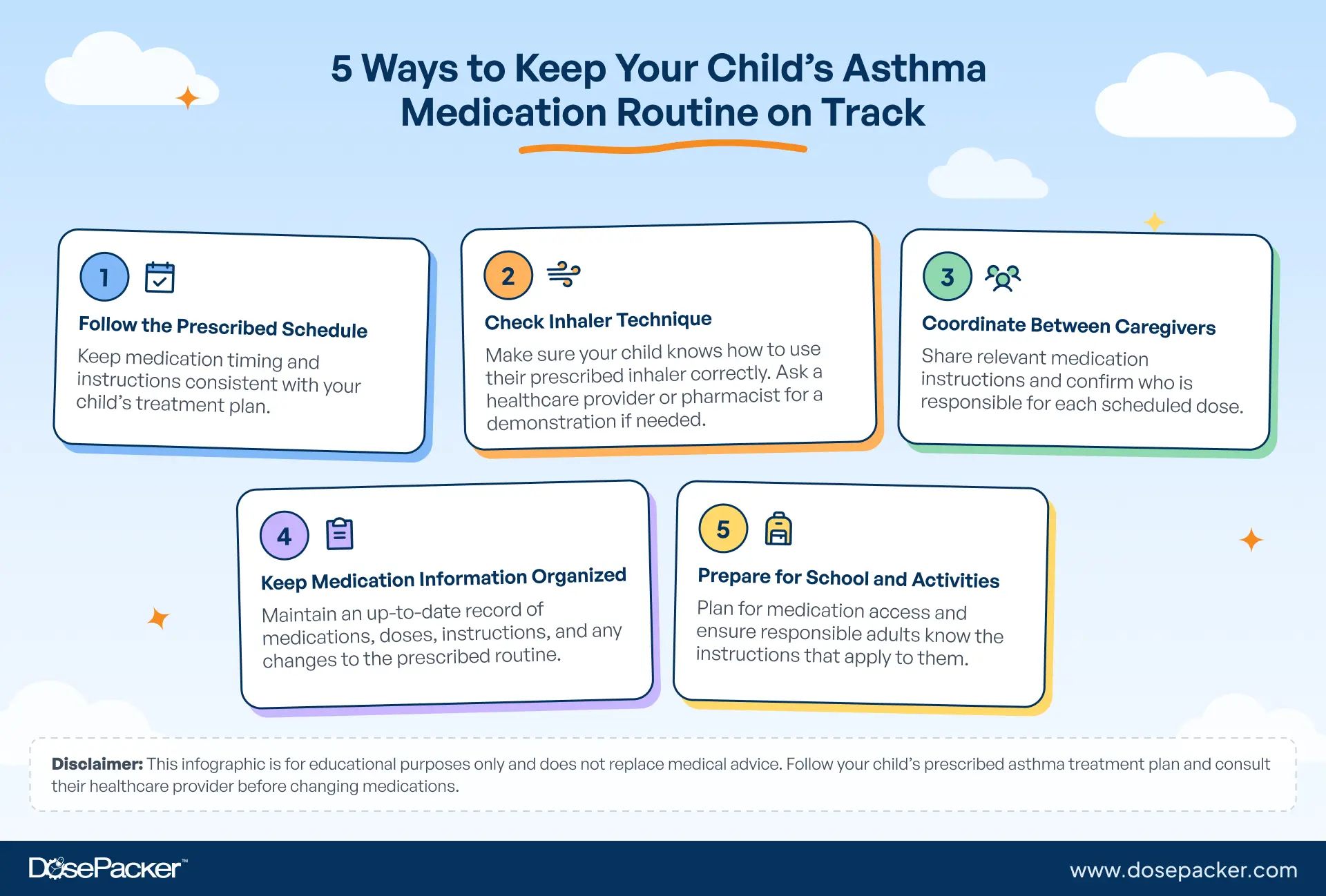
Parents should therefore make sure their child understands how to use their prescribed device and ask their healthcare provider or pharmacist to demonstrate the correct technique when needed.
The more frequently a medication needs to be administered, the more opportunities there are for the routine to be interrupted.
A study of children with asthma found that factors such as dosing frequency, caregiver changes, behavioral difficulties, and inhaler technique can affect adherence.
This does not mean parents should change the prescribed schedule. Medication frequency should always follow the child's treatment plan.
It does mean that families can look for ways to make the existing schedule easier to see, remember, and manage.
A preschooler may rely almost completely on a parent or caregiver.
A school-age child may begin learning what their medication is for and when to take it.
A teenager may take on more responsibility for managing their own routine.
That transition should happen gradually. A child's ability to manage asthma in children depends on their age, maturity, understanding, treatment complexity, and ability to follow instructions consistently.
Research on pediatric asthma adherence similarly notes that younger children depend on adult caregivers for inhaler administration, while older children gradually take on more responsibility.
Instead of thinking about medication as a separate task, parents can consider where it naturally fits into the child's existing routine.
The exact timing, of course, should always follow the child's prescribed treatment plan.
The organizational goal is simply to make those instructions easier to follow.
When caregivers must remember several medication names, doses, instructions, and administration times, memory becomes an unreliable way to stay organized.
A written medication schedule can help caregivers see what is expected and when.
Parents can also use a medication checklist to confirm important details such as:
These simple steps can support pediatric medication management without changing the child's treatment plan.
For additional guidance, families can also review medication safety tips when organizing a child's broader medication routine.
A medication routine can become more complicated when responsibility moves between adults.
If a parent gives medication before school and another caregiver is responsible later, both need a clear way to understand what has already been administered.
This is particularly important for children who spend time across different environments, such as home, school, sports activities, or another caregiver's home.
The objective is simple: everyone involved should understand the medication schedule and their role in following it.
Sometimes the challenge is not the medication itself. It is everything surrounding the medication.
A caregiver may need to find the correct container, check the label, measure or prepare the dose, confirm the time, and remember whether another caregiver already handled it.
When oral medications are part of a child's prescribed regimen, organized packaging can help bring scheduled doses together according to the established medication schedule.
For families choosing the right medication management system, the key question isn't which system has the most features. It is whether the system makes the child's prescribed medication routine easier to understand and consistently follow.
DosePacker’s multi-dose compliance packaging organizes medications into clearly identified dose slots. The packaging can provide dose-level medication and patient information, helping caregivers identify the scheduled medication more easily.
Technology can also support medication routines by solving a specific organizational problem.
For example, DosePacker's DoseMinder helps caregivers track doses and medication routines. The My Doses app can also support medication-related reminders and communication.
Technology is most valuable when it reduces confusion rather than creating another system for parents to manage.
For a family already juggling school schedules, appointments, activities, and medication instructions, simplicity should remain the priority.
Managing asthma in kids is an ongoing responsibility, and the right routine will look different for every family. Some children may need greater caregiver involvement. Others may gradually become more independent. Some may have simple medication schedules, while others may have more involved treatment plans.
The underlying principle remains the same:
Make the prescribed routine easier to see, understand, and follow.
When questions arise about medication, missed doses, side effects, inhaler technique, or changes in symptoms, parents should work with their child's healthcare provider or pharmacist. They should not change or stop prescribed asthma management medications without professional guidance.
When families evaluate medication management solutions, the most useful approach fits naturally into the child's existing routine and supports the caregivers responsible for keeping that routine on track.
Find the Right Support for Medication Organization
Disclaimer: This content is for informational purposes only and does not replace medical advice. Always follow the medication instructions your child's healthcare provider or pharmacist provides. Do not start, stop, or change an asthma medication without consulting a qualified healthcare professional.
