National Pharmacy Week 2026, taking place from October 20 to 26, honors pharmacy professionals who impact patient care daily. Learn meaningful ways to celebrate and discover how innovative medication management solutions are revolutionizing pharmaceutical care.

Picture this: A pharmacy technician fills 300 prescriptions in a 10-hour shift. That’s one every 2 minutes, including consultation time, insurance verification, and checking for potentially fatal drug interactions. Now multiply that pressure across 88,000+ pharmacies nationwide, and you begin to understand why pharmacy professionals aren’t just tired, they’re drowning.
National Pharmacy Week 2026 (October 20-26) arrives at a critical moment. While most industries celebrate achievements, pharmacy professionals are fighting a silent crisis that threatens patient safety, regulatory compliance, and the sustainability of pharmaceutical care itself. This isn’t another “thank your pharmacist” article. This is about understanding why the system is breaking and what care communities can do about it before it impacts their residents.
Here’s what most Pharmacy Week celebrations won’t tell you:
Medication adherence for chronic conditions sits at approximately 50%, according to research published in the US Pharmacist. That means half your residents aren’t taking medications as prescribed, creating preventable health crises and liability exposure.
However, what matters is that pharmacist interventions work. Studies have shown that pharmacist-led interventions improve medication adherence, and the CDC now officially recommends pharmacy-based interventions for preventing cardiovascular disease. Yet pharmacy staff are so overwhelmed with operational tasks that they can’t provide the clinical interventions that would actually save lives.
Pharmacists interact with patients 35 times annually, more than most healthcare providers, according to a pilot program analysis published in Pharmacy Times. That accessibility is the pharmacy’s superpower. But when 2 minutes per prescription is your reality, “interaction” becomes transaction.
National Pharmacy Week 2026 takes place from October 20 to 26. It’s part of American Pharmacists Month (all of October), but this year feels different.
Care communities, RCFEs, and assisted living facilities are caught in the crossfire. Regulatory scrutiny is intensifying. Staff turnover is climbing. Medication errors, even minor ones, can lead to devastating audits, litigation, and damage to reputation. Meanwhile, your caregiving staff spends hours on medication administration that technology solved five years ago.
The question isn’t “how do we celebrate Pharmacy Week?” It’s “how do we fix the broken system that’s putting our residents at risk?”
Let’s talk about what’s really happening during your facility’s med-pass:
Your staff is manually pouring from vials, counting pills, checking labels, cross-referencing MARs, documenting administration, and managing pharmacy communications, all while residents wait and other care tasks pile up. One interrupted dose becomes a cascade of delays. One labeling confusion becomes a near-miss incident report.
This isn’t a celebration article that pretends appreciation alone solves systemic problems. This is about acknowledging that manual medication workflows are:
Here’s where Pharmacy Week 2026 should redirect our attention, not to symbolic gestures, but to concrete solutions that respect the expertise of pharmacy professionals while protecting residents.
Facilities that have transitioned from traditional vial medication to multi-dose compliance packaging report transformational results. We’re talking about systems like DosePack that eliminate over 90% of manual pill-pouring through:
Maria Yeldon (Owner, Gillingham & Larchmont Manor RCFE) told us their recent audit, traditionally a stressful ordeal, had the inspector actually compliment their medication system. “Most organized med-pass I’ve seen,” the auditor said. That’s not luck. That’s systematic error elimination.
The next breakthrough is connecting medication management to your broader care operations. Software platforms like CareCommunityOS centralize resident medication profiles, health histories, and care plans in a single system that integrates with your medication delivery process.
Imagine: A physician changes a resident’s prescription. That update flows automatically to the pharmacy, appears on digital MARs, and alerts the care team, without a single phone call or fax. No transcription errors. No communication gaps. No “I thought you told them” failures.
This isn’t futuristic. This is what leading care communities implemented last year.
For seniors living independently but managing complex medication regimens, the gap between prescription and adherence is even wider. Family members worry. Primary care providers often prescribe medications without verifying that patients are actually taking them as directed. Preventable hospitalizations happen.
Technology like DoseMinder, a smart medication reminder device paired with the MyDoses App, bridges this gap with:
This isn’t about replacing pharmacy professionals. It’s about extending their expertise into patients’ homes where pharmacists cannot be physically present.
If you genuinely want to celebrate pharmacy professionals during National Pharmacy Week 2026, here are actions that matter more than cake in the break room:
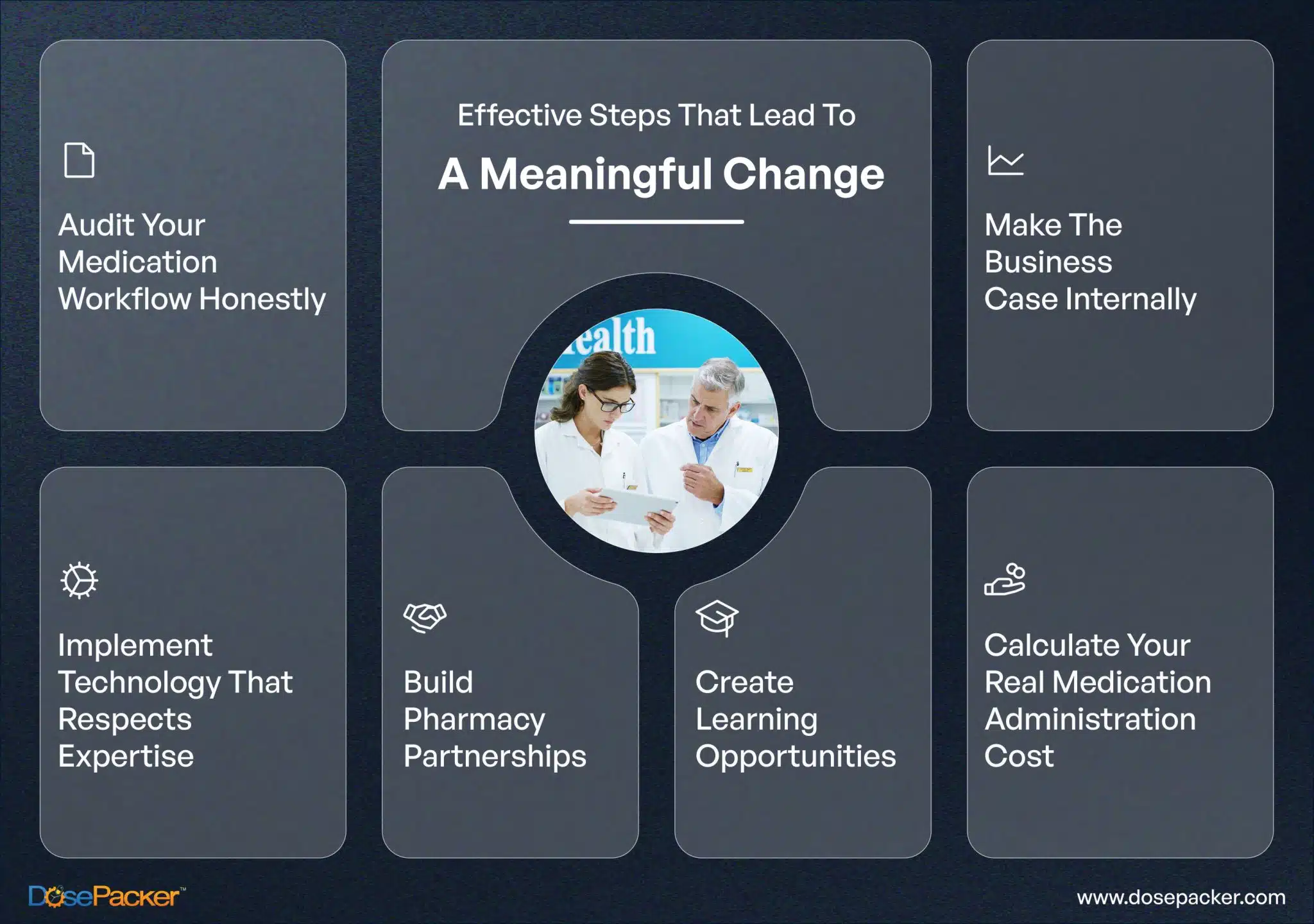
Walk through your entire med-pass process with fresh eyes. How long does it take? Count the manual steps. Identify error opportunities. Ask your staff, anonymously if needed, what scares them about medication administration. The answers will tell you where to focus.
The goal is to eliminate soul-crushing manual tasks, allowing them to focus on what they were trained for: clinical medication management, patient consultation, and care optimization. Choose pharmacy automation solutions that augment expertise, rather than diminishing it.
Add up: staff time spent on med-pass, medication errors and near-misses, documentation time, pharmacy communication hours, and audit preparation. Compare that to the cost of modern medication management systems. The ROI calculation usually surprises people.
Sponsor your pharmacy staff to attend continuing education focused on clinical services, medication therapy management, and emerging pharmaceutical care models. Invest in their expertise; it pays dividends in resident outcomes.
Transition from transactional pharmacy relationships to collaborative partnerships. Find pharmacies that offer clinical consultation, medication synchronization, compliance packaging, and proactive medication therapy management. Your residents deserve more than pill bottles.
When you implement solutions that reduce errors, save time, or improve outcomes, share those wins. Write case studies. Post on LinkedIn. Present at industry conferences. Other administrators desperately need to know what actually works.
If you’re not the decision-maker, build the business case for leadership. Document current costs, risks, and staff impact. Research solutions. Calculate ROI. Present it as a risk management and quality improvement initiative, because that’s precisely what it is.
Most National Pharmacy Week celebrations feel good but change nothing. We thank pharmacy professionals publicly while privately maintaining systems that set them up to fail. We celebrate their dedication while ignoring the structural problems that make their jobs unnecessarily difficult and dangerous.
Real recognition means fixing broken systems. It means investing in technology that eliminates preventable errors. It means redesigning workflows so that pharmacy professionals can utilize their clinical expertise instead of being overwhelmed by manual tasks. It means acknowledging that “working harder” isn’t a sustainable solution when the system itself is fundamentally inefficient.
Pharmacy professionals don’t need another pizza party. They need support, respect for their expertise, and systems that enable them to practice at the top of their license without compromising safety or their own well-being.
National Pharmacy Week 2026 will take place from October 20 to 26. Use it as a catalyst for real change.
DosePacker is offering free medication management assessments for care communities serious about modernizing their systems. We’ll analyze your current workflow, identify error risks and inefficiency, calculate potential time savings and ROI, and recommend specific solutions for your facility size and resident population.
This isn’t a sales pitch disguised as an assessment. It’s a genuine opportunity to understand where your medication management system is vulnerable and what modernization would realistically look like for your community.
Spots are limited to 50 facilities. Priority is given to communities with upcoming audits or documented challenges related to medication administration.
National Pharmacy Week should be more than a symbolic appreciation. Make it the catalyst for meaningful change in your community. Explore how DosePacker’s multi-dose packaging, CareCommunityOS software, and DoseMinder adherence technology are helping care communities eliminate medication errors, save hundreds of staff hours monthly, and transform medication administration from a liability risk into a competitive advantage.