
Behavioral health medication management can become complex as treatment plans and medication regimens change. Explore practical workflows and technology that can help care teams maintain consistency.

Behavioral health care can involve ongoing treatment decisions, medication changes, and daily support that extend well beyond the initial prescription. The need for this care is substantial: according to NIMH, 36.2% of U.S. adults aged 18-25 experienced any mental illness in 2022, compared with 29.4% of adults aged 26-49 and 13.9% of adults aged 50 and older.
For people who use medication as part of their behavioral health treatment, medication management can become increasingly complex as treatment plans evolve. A medication may be initiated, discontinued, titrated, or prescribed at a different time of day. Multiple medications may also need to be administered according to different schedules.
For care teams, the challenge is maintaining an accurate connection between the prescribed regimen and what actually happens at the point of administration. That requires more than keeping a medication list. It requires a consistent process for verifying orders, preparing doses, administering medications, documenting activity, and responding when treatment changes.
That is where behavioral health medication management becomes more than simply tracking prescriptions.
Build a More Consistent Medication Management Workflow
Medication management in behavioral health shares many principles with medication management in other areas of care, but treatment can involve additional operational considerations. Regimens may change as clinicians evaluate response, side effects, adherence, or other clinical factors.
A patient or resident may also receive medications for more than one condition, so maintaining an accurate, up-to-date medication profile is important.
Medication therapy is rarely static. A clinician may increase or decrease a dose, discontinue a medication, introduce another therapy, or change the administration schedule.
Consider James, a resident whose psychiatrist changes the dosage of one of his evening medications. The clinical decision happens during the appointment, but the medication-management process continues afterward.
The updated order must be communicated to the appropriate pharmacy and care team. The previous instructions need to be replaced, the new dosage must be reflected in the medication workflow, and the caregiver administering the evening dose must have access to the current information.
A reliable medication management mental health workflow therefore needs a clear way to carry medication changes through the operational process without relying on informal communication or memory.
People receiving behavioral health treatment may also take medications for chronic or acute physical conditions. This can create a more complicated medication regimen involving different drugs, strengths, routes, frequencies, and administration times. Behavioral health medications may also be part of a broader regimen that requires coordination across multiple prescriptions.
Polypharmacy increases the information care teams must manage. Medication names that look or sound similar, different dosage strengths, and multiple administration schedules can make manual identification more difficult.
The solution is not simply to add more checks. The workflow itself should make important medication information easier to access and verify.
Medication-related problems do not necessarily originate with the prescription itself. Gaps can develop as information moves between prescribers, pharmacies, care teams, medication packaging, administration records, and other systems.
When caregivers store and identify medications manually, they may need to cross-reference labels, medication records, resident information, dosage, and administration times.
During a busy medication pass, every additional step adds complexity.
For behavioral health medications, clearly organized, patient-specific doses can reduce manual identification before administration. This does not eliminate the need for established safety checks, but it can make the information needed for those checks more accessible.
Medication administration records provide an important record of what was scheduled and what was administered.
When documentation is separated from medication preparation and administration, caregivers may need to enter information manually or move between different systems. This can create opportunities for incomplete records, delayed documentation, or discrepancies that require follow-up.
Treat accurate documentation as part of the medication workflow, not as a task that happens after the medication passes.
A well-designed medication workflow connects each stage of the process:
Prescribe → Verify → Prepare → Administer → Document → Monitor → Adjust
Each stage has a different purpose, but a weakness at one point can affect the stages that follow.
The process begins with an authorized medication order that identifies the medication, dosage, route, frequency, and other relevant administration instructions.
Before medication reaches the administration stage, the order needs to be accurately reflected in the systems and processes used by the pharmacy and care teams.
Medication preparation should preserve the connection between the prescribed order and the individual dose.
Patient or resident identification, medication information, dosage, and administration time should remain clear throughout preparation so that the dose can be verified later.
The point of administration is when the care team confirms that the prepared medication matches the individual and the current medication order.
Depending on the setting and technology used, verification may involve checking patient identity, medication, dosage, route, time, and other applicable administration requirements.
The objective is to give the person administering the medication enough accurate information to complete the required checks without unnecessary manual searching.
Document administration accurately and promptly, following the organization's procedures and applicable requirements.
Electronic documentation can improve visibility by making administration records easier to access and review. It can also help identify discrepancies that require follow-up.
Medication management continues after administration. Information about adherence, medication-related concerns, or other observations may contribute to medication monitoring, clinical review, and future treatment decisions.
This creates a continuous cycle rather than a one-time transaction:
Order → Administration → Documentation → Monitoring → Clinical Review → Updated Order
Technology can support this cycle, but clinical decisions remain the responsibility of the appropriate healthcare professionals.
When integrated into the existing care workflow, technology can reduce manual steps and improve visibility of medication information.
The most useful systems do not simply digitize an existing process. They connect information caregivers already need during medication administration.
For example, DosePacker’s multi-dose compliance packaging organizes medications into individual, clearly identified doses, reducing the need to sort and cross-reference medications from multiple containers. Each DosePack brings key medication details together by identifying the patient or resident, medication, dosage, administration time, and pill image with the prepared dose. Color-coded cups provide an additional visual reference for different administration periods, while QR-enabled access can connect the packaging with digital medication information and documentation through the MyDoses App.
For organizations that need support beyond the administration event, DoseMinder provides reminder and monitoring capabilities that support ongoing medication routines.
For a behavioral health community, these capabilities can help connect medication packaging, digital information, and ongoing medication routines within the existing care workflow
Choosing medication management solutions should begin with the workflow rather than a list of isolated features. Organizations should identify where medication-related information currently becomes difficult to access, verify, update, or document.
When considering the right medication management system, organizations should evaluate whether the system can support the operational, clinical, and documentation requirements of their medication-management workflow.
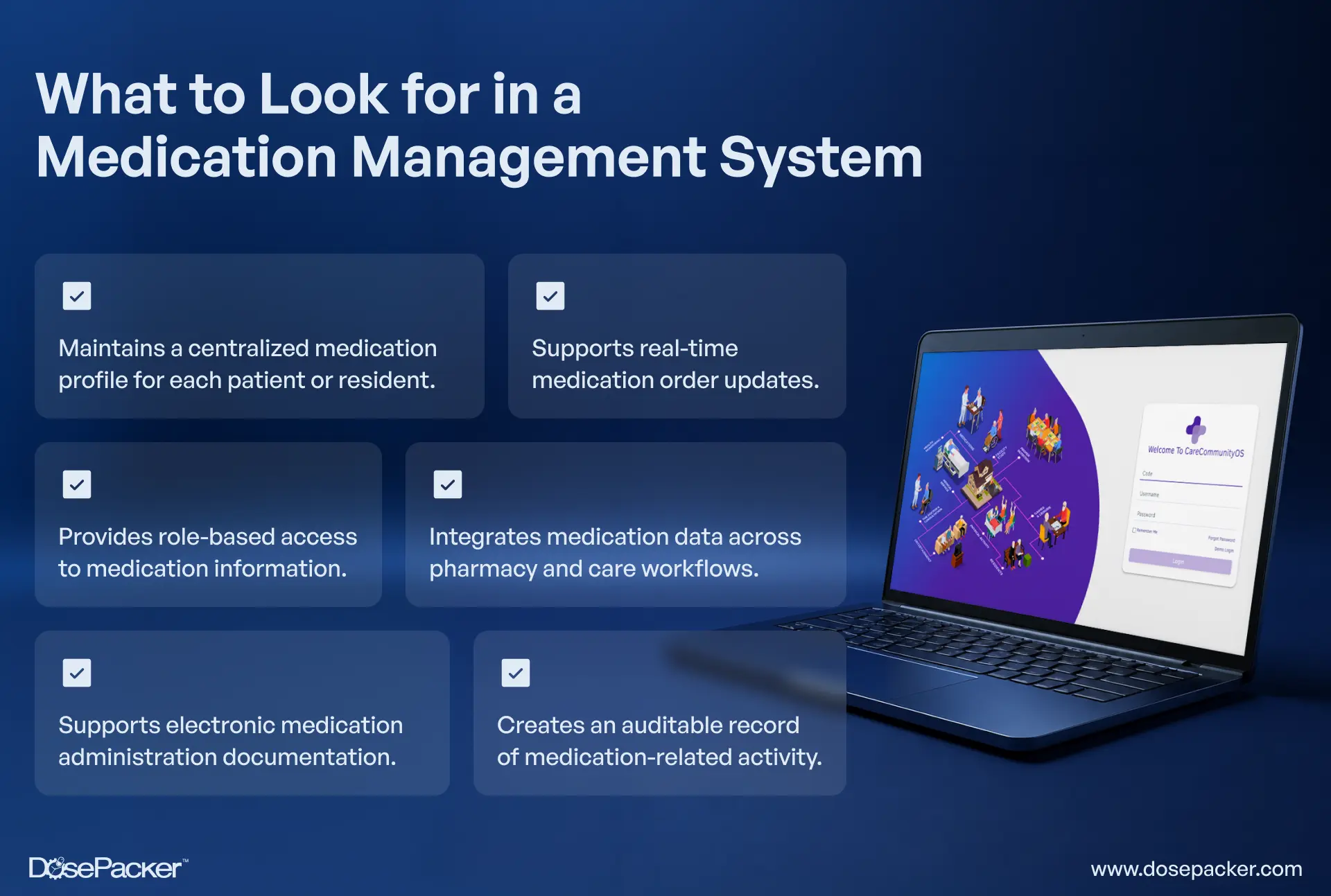
Effective mental health medication management requires continuity across the entire medication process. As treatment plans change, care teams need reliable processes that keep medication information accurate and accessible throughout the workflow.
A well-structured approach can reduce unnecessary manual steps, improve medication visibility, and help care teams maintain consistency as behavioral health medications and treatment regimens evolve. Technology can contribute by connecting medication information, administration, documentation, and ongoing medication routines within the existing care process.
For organizations evaluating psychiatric medication management and medication management solutions, the focus should ultimately remain on how well the system fits their clinical workflows.
DosePacker supports this approach through connected medication management capabilities designed to fit into established medication workflows.
See How DosePacker Fits Into Your Care Workflow
Explore connected medication management capabilities designed around the way your team manages, administers, and documents medications.
