
Operating an assisted living facility in Florida involves responsibilities that extend well beyond obtaining a license. Explore AHCA requirements, administrator and employee training, resident care, medication procedures, and inspection preparation in this practical guide.

Opening an assisted living facility in Florida comes with significant administrative responsibilities. Care communities must meet state regulatory requirements while maintaining consistent standards of resident care.
Assisted living regulations continue to evolve across the United States, requiring facility administrators to stay informed about changing requirements.
According to a review, 20 states (31%) updated their assisted living regulations in 2025, with direct-care staff education and training among the most common changes.
For Florida assisted living communities, understanding these requirements is essential to maintaining an assisted living license, ensuring staff are prepared for their roles, and keeping daily operations aligned with Agency for Health Care Administration (AHCA) standards.
This guide examines the key areas of assisted living compliance softwares for 2027 and outlines practical steps care communities can take to meet their regulatory obligations in Florida.
Make Medication Management More Organized
Before developing compliance procedures, administrators need to understand the regulatory framework governing their facilities.
Florida's Agency for Health Care Administration (AHCA) oversees assisted living facility licensing and regulation. Chapter 429, Part I of the Florida Statutes and Chapter 59A-36 of the Florida Administrative Code establish the primary requirements.
These provisions address several aspects of facility operations, including:
Florida also recognizes that assisted living facilities provide different levels of support.
For administrators, understanding these distinctions is essential when determining which services can be offered and what additional requirements apply.
A facility's ability to meet regulatory requirements depends heavily on whether its employees understand their responsibilities.
Florida addresses administrator and employee training under Section 429.52 of the Florida Statutes. Requirements vary by position and duties.
Florida requires administrators to complete the applicable core training and competency examination within 90 days of becoming an administrator, unless an exemption applies.
The training covers important areas of assisted living administration, including:
Administrators must also complete at least 12 contact hours of continuing education every two years.
These requirements help ensure administrators remain familiar with the responsibilities of managing an assisted living facility.
Medication management requires careful coordination because several people and processes may be involved in a resident's medication routine.
Understanding the factors that contribute to a medication error in assisted living is also important. Issues such as unclear instructions, communication gaps, missed doses, and inconsistent documentation can affect medication workflows. Reviewing these risks helps administrators identify areas where better procedures and staff coordination may be needed.
Florida Statute Section 429.256 addresses assistance with self-administration of medication in assisted living facilities. The law recognizes residents' ability to manage their own medications and establishes conditions under which trained unlicensed staff may provide assistance.
Distinguishing medication assistance from other medication-related responsibilities matters. Employees must work within their permitted scope, follow applicable procedures, and understand when professional intervention is necessary.
For administrators, medication management in assisted living involves more than ensuring that medications are available when required. It also involves maintaining accurate information, organizing medication supplies, communicating authorized changes, and ensuring that staff understand the procedures they must follow.
Consider a resident who returns from a medical appointment with an updated medication order.
The administrator and relevant staff must ensure that the authorized instructions reach the appropriate people. Review existing medication information and ensure the facility's established procedures reflect the change.
If different employees rely on separate records or informal communication, outdated information can keep circulating.
A clearly defined medication-change process reduces this risk.
Medication-related situations do not always follow the expected schedule.
A resident may refuse medication, a dose may be unavailable, or staff may identify a discrepancy between the medication supply and the documented instructions.
Employees should know how to respond to these situations under the facility's procedures, including when to notify the appropriate healthcare professional and how to document the event.
Administrators should periodically review recurring medication-related issues to determine whether additional training, clearer instructions, or workflow changes are needed.
Once the appropriate healthcare professionals establish a medication regimen, the facility needs a practical way to organize and manage the scheduled doses.
For facilities handling multiple residents and administration times, manually sorting individual medications can add steps to each medication round.
Multi-dose compliance packaging offers an alternative by organizing medications according to the resident's scheduled date and administration time.
Depending on the configuration, DosePacker's compliance packaging can include resident identification, medication names, dosage information, pill images, and color-coded administration times.
This allows staff to refer to an organized package rather than manually assembling each scheduled dose from a larger medication supply.
DosePacker offers features, including:
The objective is to make medication information easier to identify at the point of administration.
The packaging does not replace authorized medication instructions, clinical judgment, or facility staff responsibilities. It supports the execution of an established medication regimen.
Digital tools can complement physical medication organization.
The MyDoses app connects with DosePacker's compliance packaging through QR functionality. It provides access to medication information and can support visibility into dose activity, including records of taken or missed doses.
This creates another way for caregivers and administrators to access relevant medication information.
For care communities comparing assisted living medication management solutions, combining organized packaging with digital visibility can be a useful consideration when evaluating ways to manage medication-related responsibilities.
As facilities grow, administrators often find it increasingly difficult to manage operational information across separate records and manual processes.
Assisted living compliance software can help organize certain responsibilities, depending on the platform's capabilities.
When choosing assisted living software, senior living communities should consider ease of use, staff training requirements, data security, integration capabilities, and whether the platform supports the facility's particular licensing and operational needs.
Digital systems can help organize information, but they cannot guarantee regulatory compliance on their own.
Employees must still follow the applicable procedures, maintain accurate records, and respond appropriately to situations involving resident care.
Medication management solutions, for example, may help facilities organize scheduled doses and improve access to medication information. The facility must still maintain appropriate oversight and follow Florida's applicable medication requirements.
AHCA inspections assess whether an assisted living facility meets applicable regulatory requirements. Administrators should conduct periodic internal reviews to ensure that records are current and established procedures are being followed.
Key areas to review include:
Regular reviews can help administrators identify documentation gaps and operational issues before an inspection.
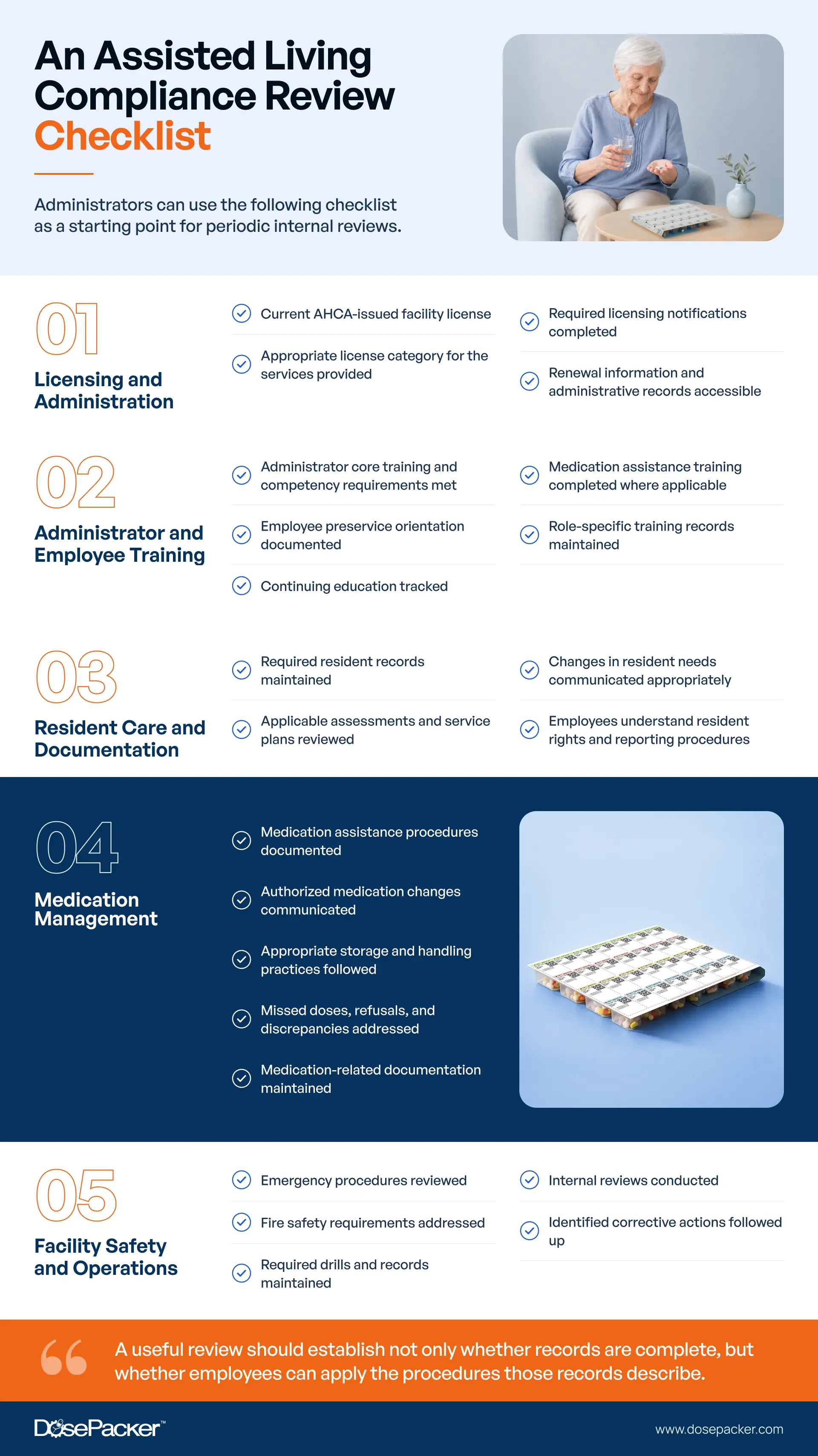
Managing an assisted living facility in Florida requires coordination across licensing, administration, employee training, resident documentation, and medication procedures.
These responsibilities do not operate independently. Administrators need processes that help employees manage these responsibilities without creating unnecessary complexity.
This includes keeping licensing records accessible, monitoring training requirements, reviewing medication procedures, and identifying areas where technology can simplify routine tasks.
These operational practices contribute to the consistency needed to build thriving assisted living facilities.
DosePacker supports one important part of this process through organized multi-dose compliance packaging and connected digital medication tools. Its solutions help make scheduled medications easier to identify and provide additional visibility into medication activity.
Looking for a More Organized Medication Workflow?
Explore how DosePacker can support your facility's established medication processes through organized packaging and connected medication information.
Medical and Regulatory Disclaimer: This article is intended for general educational purposes and does not constitute legal, regulatory, clinical, or medical advice. Florida requirements may change and vary according to facility type, license category, services provided, and resident needs. Care communities should consult current Florida Statutes, applicable Florida Administrative Code provisions, AHCA guidance, and qualified professionals when making compliance decisions.
