
California assisted living providers have to manage licensing requirements, resident care, staff training, documentation, medication processes, and ongoing regulatory changes. This 2026 guide breaks down the core areas providers need to understand to stay compliant and run more reliable daily operations.

Running an assisted living community in California involves more than providing quality resident care. Providers must keep their licensing requirements current, train staff appropriately, maintain accurate records, follow medication procedures, and stay prepared for regulatory oversight.
Medication management is one area where small process gaps can have significant consequences. A study of 4,866 medication administrations across 12 assisted living settings found that 28.2% involved a medication administration error, with wrong-time errors accounting for 70.8% of the errors observed.
This highlights why assisted living Compliance is not simply about preparing for an inspection. It is about building reliable processes that staff can follow every day.
For California providers, that means understanding the requirements surrounding an assisted living license, staff qualifications, resident care, documentation, medication management, and ongoing monitoring.
This guide explains the key areas providers should review in 2026 and how they connect to everyday assisted living operations.
Make Medication Management More Organized
Imagine an administrator preparing for a routine compliance review.
The first questions are straightforward: Is the facility's license current? Are administrator certifications up to date? Have staff completed the training required for their roles? Are resident records current? Can the team explain how they receive, store, administer, document, and update medications?
Many California assisted living communities operate as Residential Care Facilities for the Elderly (RCFEs), which the California Department of Social Services (CDSS) licenses and monitors. The regulatory framework covers areas including resident care and supervision, staffing, administrator qualifications, medication-related practices, documentation, and facility operations.
That means assisted living compliance becomes part of the facility's operating model. Licensing lays the foundation, while the facility's daily processes determine how it meets those requirements.
The challenge for administrators is keeping those processes aligned as residents, staff, medications, and facility operations change.
Getting an assisted living license gives a community the authority to operate. Maintaining compliance requires ongoing attention after the initial approval.
A community may look very different several years after opening. Staff members change. Residents have different care needs. Medication regimens are updated. Policies evolve. Technology is introduced. Even administrative responsibilities can shift.
Each change can affect the way a facility meets its existing obligations.
An administrator should know what the current license covers and whether facility changes require additional review.
For example, changes involving ownership, location, services, or facility operations may create new licensing or regulatory considerations. Keeping licensing information current therefore becomes part of routine administration rather than something reserved for renewal or inspection periods.
The same principle applies to the assisted living facility license itself. Keeping a copy on file is useful, but administrators also need confidence that the facility's actual operations continue to match its approved structure and applicable requirements.
This is where regular internal review becomes valuable.
Rather than waiting until an inspection is approaching, administrators can periodically look at the areas most likely to change: staffing records, certifications, resident documentation, medication procedures, incident records, and facility policies.
That approach gives the administrator a chance to identify a gap while it is still an operational issue, rather than discovering it when someone else is reviewing the facility.
A facility can have well-written policies and still struggle if employees are unclear about how those policies apply to their work.
California's RCFE administrator requirements establish a formal training and certification framework. CDSS currently requires an initial 80-hour Initial Certification Training Program for RCFE administrators, with 20 hours permitted in a self-paced format. Renewal requires 40 hours of continuing education each certification cycle, including specified education on laws, regulations, policies, procedural standards, and dementia.
But certification is only one part of the administrator's role.
Consider a medication change.
A physician or other authorized healthcare professional changes a resident's medication instructions. Someone must ensure the updated information reaches the appropriate people, the old information is no longer followed, and the medication workflow reflects the change.
The same applies when a resident refuses a medication, when a dose cannot be located, or when staff identifies a discrepancy.
These situations require more than knowing that a policy exists. Staff need to understand what they are responsible for doing, when to document an event, and when to escalate an issue.
That is why training works best when it connects directly to the situations employees encounter during a normal shift.
Administrators also need a practical way to monitor whether required training remains current.
A training record may show that an employee completed a course. Day-to-day observation and internal review provide a different kind of information: whether the employee understands the procedure and can apply it correctly.
For a facility, that distinction can make ongoing assisted living compliance much more manageable.
Medication management sits at the intersection of several responsibilities.
A resident may have multiple prescriptions, different administration times, special instructions, changes from a healthcare provider, and medications that require different handling. Staff then have to translate all of that information into a routine that works during busy shifts.
That is why medication management in assisted living deserves its own place in a compliance review.
According to a National Library of Medicine study, medication errors affect approximately 5% of the United States population. The challenge is rarely just one person making one mistake.
A medication can be difficult to identify. A schedule may have changed. Information may not have been updated everywhere it needs to be. A staff member may be working under time pressure. Documentation may happen after the administration rather than as part of the workflow.
Each point in that chain can affect what happens next.
A medication error does not necessarily begin at the point of administration.
It can develop earlier, when information is transferred, a medication is organized, a schedule is interpreted, or a change is communicated to staff.
For an administrator reviewing a medication error in assisted living, the surrounding workflow matters as much as the final event.
Suppose a resident's evening medication is consistently difficult for staff to identify. The immediate issue may seem like an administration problem. A closer review could reveal that staff manually separate medications from larger supplies, several residents have similar schedules, or updated instructions aren't presented in the same place.
The corrective action then becomes much clearer.
Instead of simply reminding staff to "be more careful," the facility can examine the process that made the error more likely.
That is where operational improvements can have a meaningful role.
Once the appropriate healthcare professionals establish a medication regimen, the facility must execute it consistently.
For communities managing many residents and multiple administration times, manually sorting medications can add another layer of work to every shift.
Compliance packaging can support the established workflow.
DosePacker's multi-dose compliance packaging organizes medications according to date and administration time. Depending on the configuration, each dose can include resident identification, medication and dosage information, medication images, and color-coded administration times.
The goal is straightforward: make the established dose easier for staff to identify at the point of administration.
Consider the difference between opening a medication supply and manually determining which medications belong together for a particular administration time versus receiving a dose that has already been organized according to the established schedule.
The prescribing and healthcare team still makes the clinical decision.
The facility's responsibility remains the same.
The workflow, however, can become easier to follow.
DosePacker can provide date- and time-based organization, medication identification, pill images, color coding, tamper-evident packaging, and QR connectivity with MyDoses.
This gives staff a clearer physical representation of the medication schedule they already follow.
Technology can help facilities organize information, reduce repetitive work, and give administrators better visibility into daily processes. The key is choosing tools that fit the workflows staff already use rather than adding another disconnected system.
When choosing assisted living software, administrators should look at where staff spend unnecessary time searching for information, duplicating documentation, or managing tasks manually. A useful solution should make those workflows easier to manage while remaining practical for everyday staff use.
For medication management, the same principle applies. Physical organization can make scheduled doses easier to identify, while digital tools can provide greater visibility into medication activity.
For communities evaluating assisted living medication management solutions, DosePacker combines organized compliance packaging with digital tools that support medication workflows. DosePacker's MyDoses platform can provide reminders and records of taken or missed doses, giving caregivers and administrators greater visibility into medication activity.
These medication management solutions can support established facility processes while keeping prescribing decisions and clinical judgment with qualified healthcare professionals.
A periodic internal review can help administrators spot gaps before they become inspection findings. Use this 2026 review to check the areas that matter most:
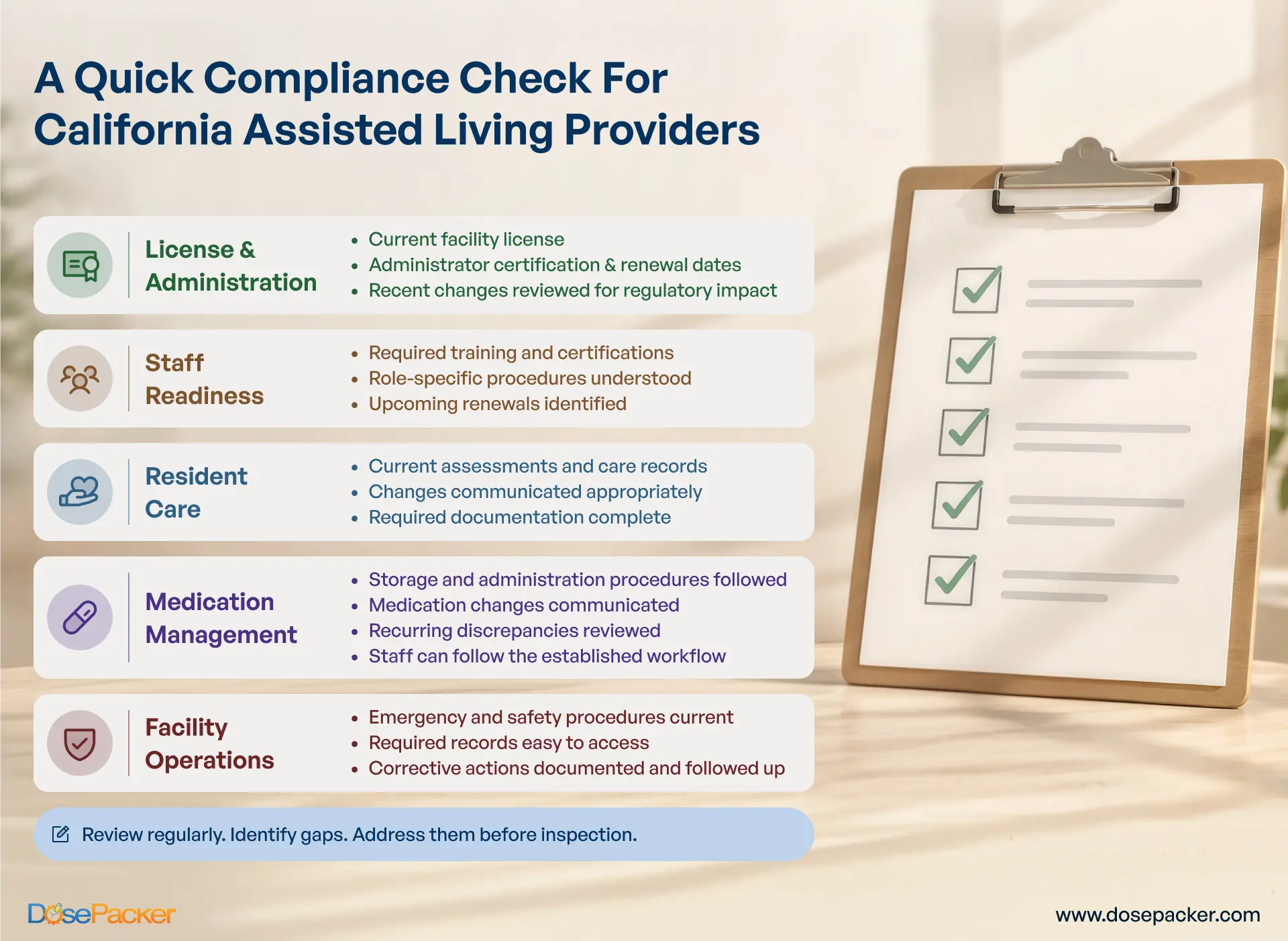
For administrators, compliance ultimately comes down to how well the right processes work together in everyday operations. Current licenses, trained staff, clear policies, organized medication workflows, accessible documentation, and regular internal reviews all contribute to a more consistent care environment. For medication management, the focus should be on making established processes easier for staff to follow and maintain.
DosePacker supports this approach through organized compliance packaging and connected medication-management tools designed to fit existing workflows, helping providers build more reliable operations and thriving assisted living facilities.
Looking for a More Organized Medication Workflow?
See how DosePacker can help organize established medication schedules and support greater visibility across medication administration workflows.
Medical and Regulatory Disclaimer: This article is for general educational purposes and does not constitute legal, regulatory, clinical, or medical advice. California requirements may change and vary by facility type and services. Providers should consult current CDSS requirements, applicable California laws and Title 22 regulations, and qualified professionals when making compliance decisions.
