
The 340B program is undergoing its most significant operational shift in 30+ years. This guide breaks down what covered entities need to know about the rebate model pilot launching in January 2026.

The way covered entities receive 340B drug discounts is fundamentally changing for the first time since 1992, post the presidential order issued on April 15, 2026.
Starting in just a few weeks, select high-cost medications will no longer be eligible for upfront pricing discounts. Instead, covered entities must pay full Wholesale Acquisition Cost and wait for manufacturer rebates, creating immediate cash-flow pressure that could reach millions of dollars for many organizations.
Understanding this pilot program is essential for every covered entity that depends on the 340B drug pricing program. Whether you manage a disproportionate share hospital, a federally qualified health center, or oversee 340B contract pharmacy services through partners like DosePacker, staying informed is vital to protect your savings and ensure uninterrupted patient care.
View DosePacker’s Contract Pharmacy Solutions
As this pilot rolls out, the rebate plan becomes the most important detail to understand. Here is what the new approach means for covered entities and contract pharmacy partners.
In July 2026, the Health Resources and Services Administration ( HRSA ) announced a voluntary pilot program that rewrites decades of established 340B operations. Rather than purchasing drugs at reduced 340B ceiling prices, covered entities must now buy select medications at Wholesale Acquisition Cost (WAC) and submit claims to manufacturers for backend rebates.
This isn’t a minor adjustment to existing processes; it’s a complete operational overhaul that affects purchasing, inventory management, billing workflows, and financial forecasting.
The pilot targets ten drugs currently subject to Medicare drug price negotiations under the Inflation Reduction Act. These include some of the highest-cost pharmaceuticals in outpatient settings: Eliquis, Jardiance, Xarelto, Januvia, Farxiga, Enbrel, Imbruvica, Stelara, Entresto, and Novolog/Fiasp.
Covered entities have just 45 days from the date of dispense to submit those claims through HRSA’s new Beacon platform. Participating manufacturers must process rebate claims within 10 business days of submission. While currently limited to ten drugs, HRSA has explicitly indicated the model could expand based on pilot results and stakeholder feedback throughout 2026.
The shift from upfront discounts to backend rebates creates an immediate, severe cash flow challenge that many covered entities are unprepared to handle.
According to a comprehensive analysis by 340B Health, the financial burden is staggering and scales with facility size. Disproportionate share hospitals with fewer than 138 beds could face approximately $8.9 million in annual drug cost float (money that must be fronted before any rebate arrives).
For larger facilities with over 487 beds, that figure balloons to $208 million. Critical access hospitals, operating on already razor-thin margins, still face $1.7 million in additional cash requirements.
This isn’t theoretical. The money that previously supported patient assistance programs, free specialty clinics, extended hours, or expanded services is now tied up in inventory costs, waiting in a manufacturer’s rebate queue.
The administrative complexity compounds the financial pressure. Pharmacy teams must now track every claim submission through Beacon, monitor rebate approval statuses, reconcile payments against original purchases, manage denials and resubmissions, and maintain audit-ready documentation for all transactions.
For facilities already managing medication packaging and dispensing alongside clinical services, this represents a massive shift in daily operations that requires new systems, additional staff training, and often technological infrastructure upgrades.
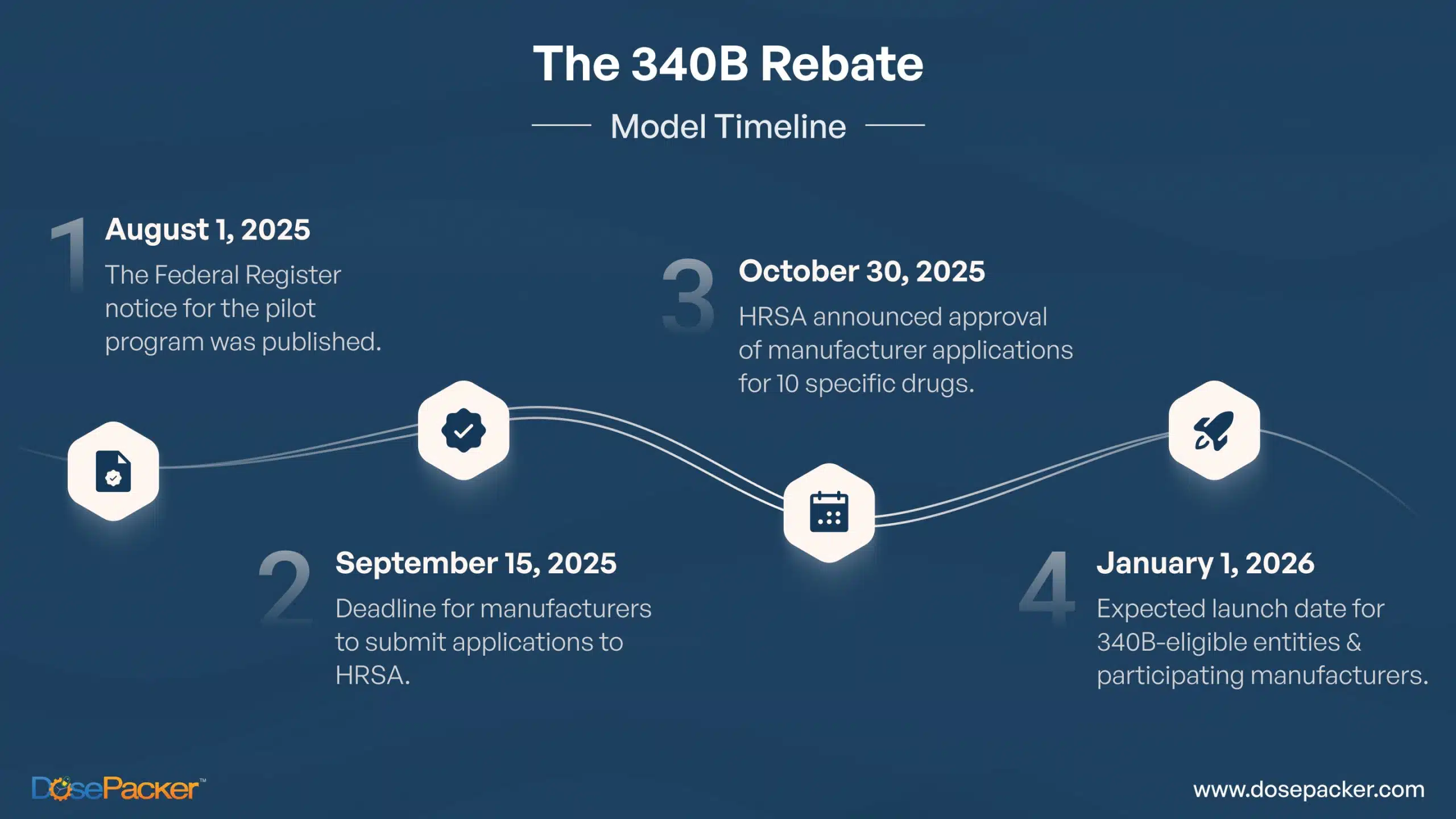
The January 2026 deadline demands immediate action. Organizations that wait to prepare will find themselves scrambling to implement complex systems under impossible timelines.
Can your current pharmacy management system handle real-time rebate claim submission through Beacon? Most legacy systems weren’t designed for this level of integration. You’ll need either significant system upgrades or strategic partnerships with technology-forward providers. For covered entities working with 340B contract pharmacy partners, this becomes even more critical; every pharmacy location in your network needs seamless connectivity to the rebate processing platform.
Work with finance teams immediately to calculate the cash impact of carrying WAC-priced inventory for affected drugs. Identify credit line needs, budget adjustments, or reserve fund requirements to maintain operational stability. Don’t underestimate these numbers; a single high-cost specialty medication can represent tens of thousands of dollars in temporary exposure.
The rebate model requires precision. Every claim needs accurate patient encounter data, proper 340B eligibility verification, and correct NDC coding. Errors don’t just delay payments; they trigger denials that can significantly impact your financial performance. Review your current accuracy rates and implement quality control checkpoints.
This isn’t just a pharmacy department issue. Billing teams, compliance officers, finance personnel, and clinical staff all need training on new workflows. Create comprehensive training programs that cover claim submission, reconciliation procedures, denial management, and audit trail maintenance.
For organizations that use automated medication dispensing systems and 340B contract pharmacy services, such as those offered through the DosePacker network, integrating rebate tracking with existing pharmacy automation becomes essential for maintaining efficiency during this complex transition.
The initial pilot includes ten medications subject to Medicare price negotiation under the Inflation Reduction Act:
HRSA has committed to collecting comprehensive stakeholder feedback throughout the pilot year. The data gathered will directly inform whether the rebate model is expanded, modified, or discontinued entirely.
This creates both uncertainty and opportunity. Covered entities should meticulously document operational challenges, quantify financial impacts, and track effects on patient care continuity. This feedback will prove invaluable as HRSA shapes the program’s future.
In the meantime, focus on operational readiness. The organizations that navigate this transition successfully won’t necessarily be the largest or best-funded; they’ll be the ones that automate intelligently, prepare thoroughly, and adapt quickly to evolving requirements.
The 340B rebate model represents a fundamental transformation that will test every aspect of your pharmacy operations infrastructure. Success demands modern technology, streamlined workflows, and reliable partners who understand the unique challenges facing covered entities.
DosePacker specializes in 340B contract pharmacy services designed specifically for this new rebate-based environment. We help covered entities maintain operational efficiency while adapting to complex regulatory changes with a team of seasoned 340B program experts.
Discover how strategic partnerships can protect your program’s financial integrity while preserving the patient care mission that matters most.
Don’t wait for January to force your hand. The time to prepare your 340B program for the rebate model is right now.
